
Digital Medicine: KIT Center for Health Technology Presents Itself at Karlsruhe City Hall
Whether electronic prescriptions, telemedicine or computer-controlled diagnostics: digitalization has long since arrived in healthcare, and new innovative research projects in the field of medicine are presented almost daily. The Karlsruhe Institute of Technology (KIT) also wants to get involved in this field of research.
In March 2023, the KIT Center for Health Technologies was launched for this purpose. A good ten months later, the center will be presenting some of its key research areas at Karlsruhe City Hall on Monday, January 29, starting at 6:30 pm. The program includes a lecture on “Artificial intelligence and machine learning in medicine” as well as a data-driven look into the future of sports and health research in childhood.
Digitalization of precision medicine was driven forward in Karlsruhe
Bioscientist Prof. Dr. Andrea Robitzki from KIT is satisfied with the first ten months. “A lot has happened since the center was founded,” says the center’s spokesperson in an interview with karlsruhe.digital. “We have helped to drive forward digitalization in the healthcare sector and in precision medicine.” The center’s employees have also initiated numerous new research projects and successfully acquired third-party funding for them.
KIT is well networked with hospitals in the region
The fact that there is no medical faculty at the Karlsruhe universities, such as in Heidelberg, Tübingen or Freiburg, is not an obstacle for Robitzki. “KIT has a great deal of expertise in the fields of artificial intelligence and deep learning,” says the center spokesperson. In addition, research in the field of humanoid robots is a good basis for further projects in the healthcare sector. “And, of course, we are also very well networked with the medical faculties and hospitals in the region,” says Robitzki.
Health center works on an interdisciplinary basis
Interdisciplinarity is also the big trump card at the new center. Computer scientists and sports scientists work hand in hand, as do researchers from the fields of medical technology and technology assessment. “There is no longer any fear of contact,” says Robitzki. In the meantime, communication barriers between tekkies from the world of computer science or medical technology and researchers from the humanities or the sports institute have also been broken down.
“The wide-ranging expertise and diverse activities at KIT form the basis for the coordinated expansion of the topic of health technologies,” says Professor Oliver Kraft, Vice President for Research at KIT. “Above all, we want to combine basic research in various fields with applications in health technologies. We are thus responding to the needs of an ageing society, supplemented by modern and new offers for research-oriented studies.”
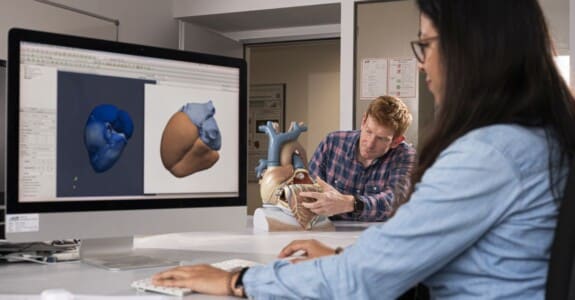
Cover picture: Dr.-Ing. Axel Loewe (IBT) and Lourdes Patricia Martinez Diaz with a classic heart model and multiscale models on the screen. Photo: Karlsruhe Institute of Technology