
Robotics for the Environment: New Ideas from Karlsruhe
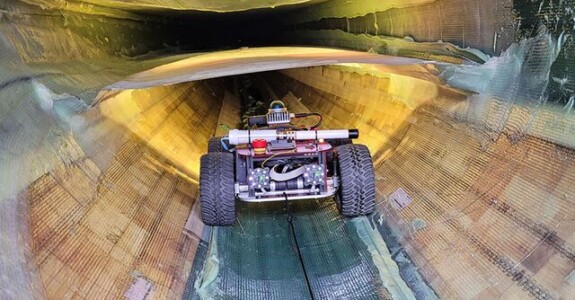
The image of robots is often still associated with industrial plants, assembly lines, and automation. Hardly anyone thinks of environmental protection first. And yet, this is precisely where a new field is emerging: robotics that helps conserve resources, reduce environmental impact, and promote more sustainable practices.
Work is underway in Karlsruhe—not only in laboratories, but also at the structural level. We spoke with Anne Gunkel of Digital Green Tech Robotik about this.
Robotics Meets Sustainability
The Karlsruhe Institute of Technology is home to project management organizations that play a central role in the innovation system. They do not conduct research themselves, but rather facilitate research. Anne Gunkel of Digital Green Tech Robotik explains: “We provide research funding on behalf of federal or state ministries, but we don’t actually work within the ministries themselves.” Instead, they develop funding programs, support projects over the course of several years, and ensure that the results are actually put into practice.
This is exactly where the Digital Green Tech Robotics initiative comes in. It specifically brings together robotics, artificial intelligence, and environmental technology. The idea arose from an observation: While many industries are undergoing digital transformation, this is often happening only sporadically in the field of environmental technology. At the same time, AI and robotics are advancing rapidly. “Robotics benefits greatly from artificial intelligence. This opens up entirely new possibilities for us,” explains Gunkel.
At first glance, the result seems contradictory: high technology in the service of sustainability. But it is precisely this combination that holds enormous potential. “If you truly use digitalization to promote sustainability, it usually has a positive effect,” she says. While technology itself consumes energy and resources, it can make processes more efficient, conserve materials, and reduce environmental impact.
Robotics in Action
“We thought this wasn’t such a big topic yet, and then we ended up with quite a few submissions.”
It quickly became clear that the topic struck a chord. In agriculture, for example, researchers are working on robots that selectively remove blossoms from fruit trees. What may sound unremarkable at first has a major impact: it helps stabilize yields—without the use of chemicals. “There is extreme interest in such solutions, particularly from the organic farming sector.”
Other systems handle the growing volumes of used textiles. They identify materials, sort garments, and determine whether they can be recycled or reused. What seems obvious to humans is highly complex for machines. “This is a soft fabric; you have to stretch it out and inspect it, and that’s a huge challenge for robots,” explains Gunkel.
Robots are also in use underwater and in the air. Floating systems monitor bodies of water, detect pollutants, and can trace their source. In the energy sector, meanwhile, robots are used to inspect wind turbines. Here, the robots take on tasks that would be dangerous for humans: “It’s like an extended arm for the person actually doing the job.”
More Than Just Automation
The fear that robots will replace human workers has accompanied such developments for decades. But the reality is often quite different. “We very often face the problem that there are jobs that simply no one wants to do anymore,” she says. Working in sewage systems or on wind turbines is physically demanding, risky, and difficult to staff. This is where robots can really help alleviate the burden. At the same time, new tasks are emerging in development, maintenance, and control. Fully autonomous systems, on the other hand, are still a long way off.
For such technologies to be deployed at all, they must not only work but also be socially accepted. That is why funding has been linked to legal and ethical research from the very beginning. “If we have a great technical advancement but aren’t allowed to use it, it’s of relatively little use to us,” she says. Issues such as data protection, security, and use in public spaces play a central role here. Perceptions are also changing. Drones, for example, are now more strongly associated with military applications, according to Gunkel: “As a society, we need to clarify: Where are robots allowed to go, and where are they not?”
BRIDGE supports the transition to practical application
To ensure that robotic solutions not only function technically but also meet legal, ethical, and societal requirements, the BRIDGE research project provides scientific support to the projects funded by the Federal Ministry of Research, Technology, and Space (BMFTR) under the “Digital GreenTech Robotics” funding initiative. The accompanying project supports the collaborative projects in areas such as legal issues, ethical challenges, standardization, and knowledge transfer.
The goal is to support the development of intelligent robotics for challenging environmental conditions—not only from a technical perspective but also in terms of its practical applicability. To this end, BRIDGE analyzes legal frameworks, develops recommendations for action, and promotes dialogue among researchers, industry, and other stakeholders. The project is led by the FZI Research Center for Information Technology in Karlsruhe. Other partners include the International Center for Ethics in the Sciences (IZEW) and DIZ | Digital Innovation Center GmbH.
An Industry with Potential
Nevertheless, the industry is often underestimated. “The environmental technology industry is a fairly major driver of the economy—especially in Baden-Württemberg—yet it isn’t really recognized as such.” Unlike the automotive industry, it lacks visibility, partly because it spans many different sectors: water, energy, recycling, and agriculture. So far, there has been virtually no unified voice or advocacy group representing its interests.
A Look into the Future
What will all of this look like in the future?
“What still seems innovative to us today will then be standard,” says Gunkel. One example is robotic dogs: Just a few years ago, they were still considered a technical gimmick, but today they’re already performing inspection tasks, such as along railroad tracks.
At the same time, many questions remain unanswered: new applications, new technologies, and new questions. Perhaps the key factor isn’t the technology itself, but the collaboration behind it. Environmental and technology communities are still often separate from one another. Initiatives like Green Robotics are trying to change exactly that.
Or, as Anne Gunkel puts it:
“Perhaps it would be better to work together on the major challenges rather than constantly reinventing the wheel in individual industries.”