
Real-world laboratory in Karlsruhe: autonomous driving test field open to companies and research institutions
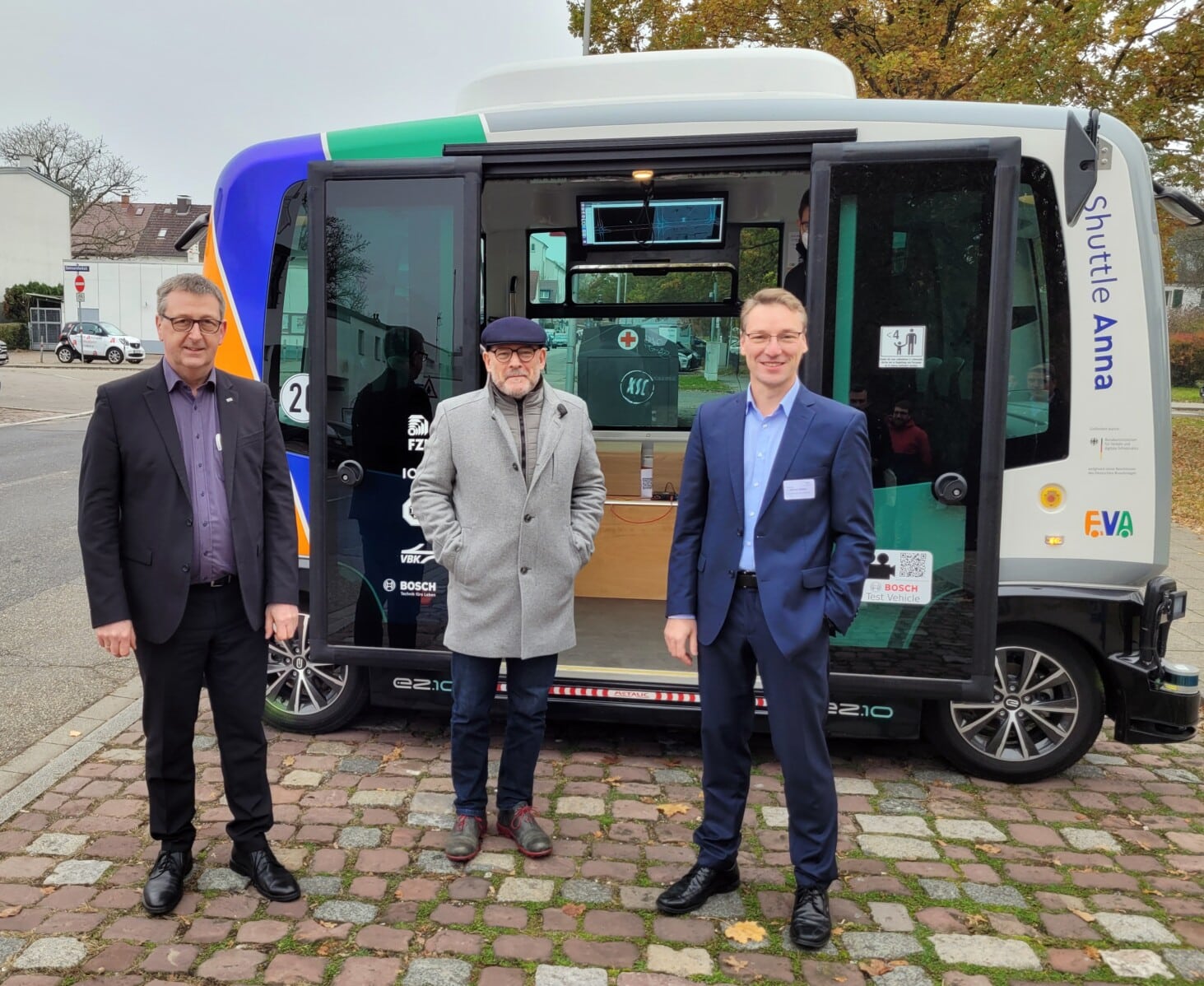
Cover picture: Baden-Württemberg autonomous driving test field
When Karlsruhe was awarded the contract for the Baden-Württemberg Test Area for Autonomous Driving (TAF) in October 2016, the future operator consortium was delighted. For five years, the Karlsruhe public transport company and numerous partners from science and industry have been working intensively on the infrastructure for the test field operation and have launched lighthouse projects such as the EVA shuttles in the Weiherfeld-Dammerstock district of Karlsruhe.
“The foundation has now been laid and the sensor technology expanded,” emphasized TAF Director Prof. Dr. Marius Zöllner at a specialist event in Karlsruhe on 12 November 2021. Companies, research institutions and mobility service providers will be able to test their technology for connected and autonomous driving on over 200 kilometers of road while traffic is moving. “It’s a real-world laboratory,” the Director of the Research Center for Information Technology (FZI) clarified, and it goes without saying that the operating team would support all external development companies with their expertise.

Transport Minister Winfried Hermann is pleased about the hype in Karlsruhe
“Awarding the test field to Karlsruhe was absolutely the right decision,” emphasized Baden-Württemberg’s Transport Minister Winfried Hermann. The open invitation to tender and the intense competition between several municipalities for the award of the funding had created a “veritable hype” around autonomous driving. According to Hermann, Karlsruhe has impressed not least with its mix of closed-off test field areas on the Campus East of the Karlsruhe Institute of Technology (KIT) and the inner-city routes on the Südtangente and Ostring as well as the outposts in Heilbronn and Bruchsal, but also with its high density of IT companies and the great expertise in the field of digitalization in the research institutions. For the Minister of Transport, however, regular dialog with the public is almost as important in the further development of autonomous driver assistance systems. “People need to understand what research is being carried out on their doorstep,” says Hermann. “Only then will they trust the self-driving cars later on.”

EVA shuttle lighthouse project
A public dialog on the experiences with the EVA shuttles also took place the day after the specialist event at the Alter Schlachthof creative park. “The fact that we are linking the research for the test field directly with local public transport is certainly another special feature of Karlsruhe,” said VBK Commercial Director Alexander Pischon. In summer 2021, the three electric, networked and autonomous EVA shuttles with the melodious names Ella, Vera and Anna were on the road in the Weiherfeld-Dammerstock residential area. Several hundred residents took advantage of the offer and used the shuttles to travel to the nearest streetcar stop or to go shopping. “Almost no safety concerns were expressed, most people simply accepted the offer gratefully,” says Pischon. The results will now be evaluated and the next steps will be taken to further develop the shuttles.

Important contribution to the mobility turnaround
For Karlsruhe’s Lord Mayor Frank Mentrup, projects such as the EVA shuttles
are also an important contribution
to the desired mobility turnaround. “We need to reorganize transport,” continues