
From ABC to code - programming in elementary school

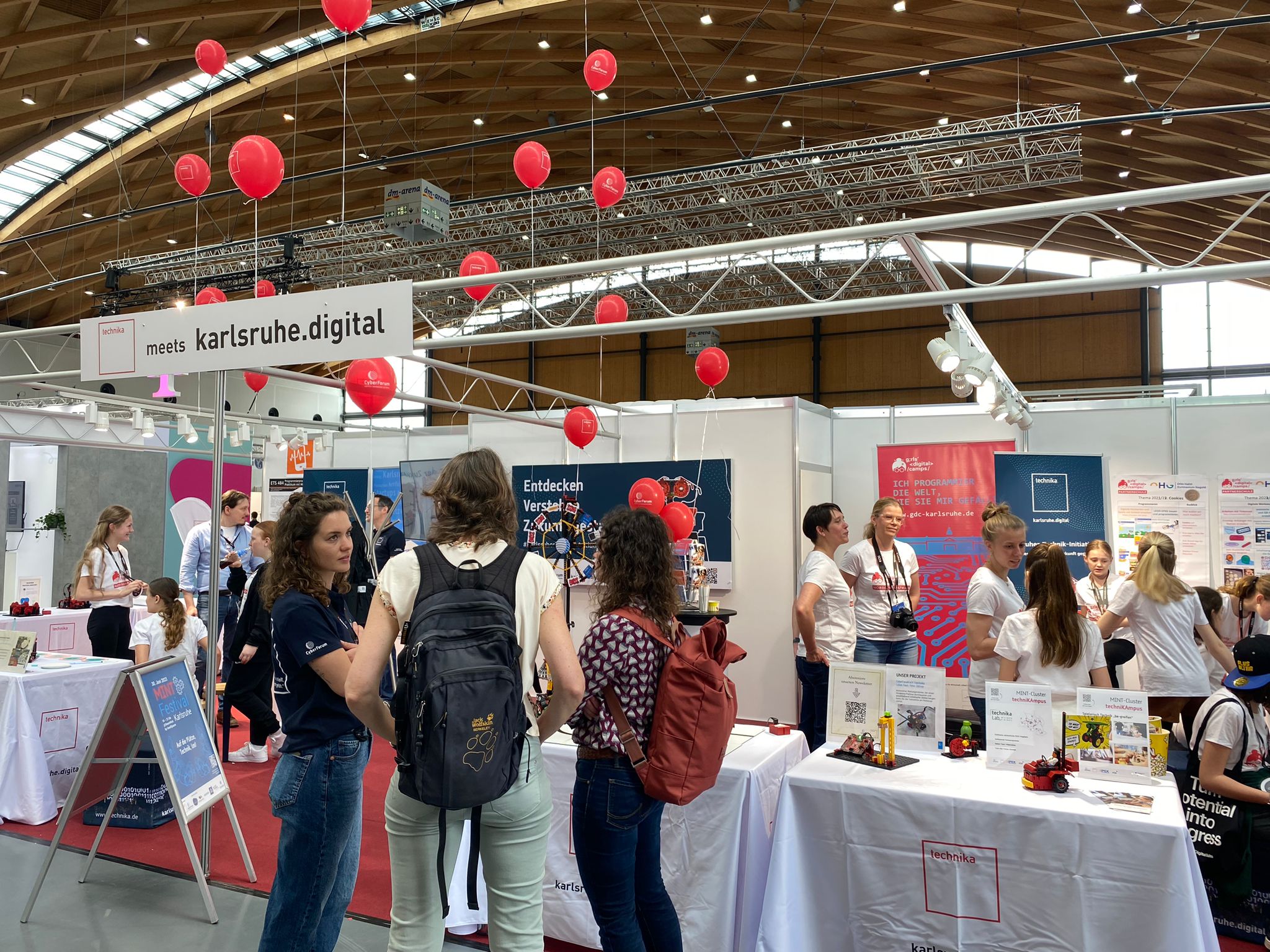
10 years of technika. Programming is no longer an exotic specialty. For Dirk Fox, founder of the Karlsruhe-based technology initiative technika, it even belongs in elementary school. technika, an initiative of CyberForum e.V., organizes fischertechnik AGs at schools and is the largest regional STEM initiative in Germany. It is now celebrating its 10th anniversary.
technika is currently working with fischertechnik on a project to bring robotics into elementary school. The state has already issued a call for tenders on this topic. This would finally bring STEM education, which is so fundamental for children, into mainstream lessons.
Ariane Lindemann talks to Dirk Fox about the beginnings of technika and its successes.
How did the idea of bringing fischertechnik into schools come about?
Through a phone call from my father ten years ago. He asked what he should do with the old fischertechnik construction sets in the attic. I drove there, picked them up and built my old favorite models until six in the morning. My three sons jumped right in and were just as enthusiastic as I was as a child. At the same time, I came across a study by acatech in which thousands of engineers, schoolchildren and students were asked what brought them to IT and technology. Most of them said: Building, repairing and technical toys. But who still takes a hairdryer apart when it’s broken? And the good old tinkering room with screw clamps and upright drills – they’re practically non-existent.
This means that a huge area of experience for the children is lost in practice …
That’s the point. So I came up with the idea of giving the children in the school a children’s room with technical toys – to create a real paradise for technology-loving kids. The plan was to equip classes with fischertechnik construction sets and introduce the children to the subject of technology in a playful way.
Did the schools bite straight away?
I wrote a concept and presented it to the principal at my children’s school. He was enthusiastic and we founded the first working group at Bismarck-Gymnasium. We started with 25 pupils in the seventh and eighth grades. It was a resounding success. We soon had 50 children in the club, who were building and constructing with great enthusiasm. In 2014, we equipped seven more schools. The idea exploded. We were able to attract numerous sponsors and supporters who continue to help equip schools with fischertechnik to this day.

The team has also grown quickly …
In 2017, we received an award from the Körber Foundation as part of the MINT Region funding competition. We were able to use the prize money to finance a half-time position at the CyberForum for six months. In 2018, entrepreneur Hans Hubschneider stepped in with his foundation. He remains an important financial supporter of the technika staff positions at the CyberForum to this day. We have just filled our sixth position and also two FSJ positions, which we were able to fill for the second time. Last year, we also had a computer science professor from Karlsruhe University of Applied Sciences who spent his research semester with us to develop didactic material for students.
In 2021, there was a special award with “Wirkung Hoch 100″…
The “Wirkung hoch 100” award, which the Stifterverband presented on its 100th birthday, was sensational and showed us that we are on the right track. We were honored as one of the ten best ideas for the education, science and innovation system of tomorrow.
The enthusiasm for the fischertechnik AGs is still unbroken today…
Absolutely. Demand is increasing. We now have 150 working groups at schools and public institutions, with which we reach up to 2,500 children every week. This makes us the largest regional STEM initiative in Germany. There is no other initiative of this size.
“We are the largest regional STEM initiative in Germany. There’s nothing else like it on this scale.”
Dirk Fox
The new education kits are even going abroad …
In 2020, we started developing didactic kits for fischertechnik for school lessons from third to 12th grade. It’s going through the roof right now. We now have over 20 educational construction sets that are not only used in German schools, but also abroad. fischertechnik is particularly popular in countries with a centralized education system – such as the United Arab Emirates, China and Brazil. These emerging countries have a strong focus on educating their children like German engineers.
What is included in the kits?
We cover the entire field of mechanics and statics, i.e. gear ratios, stable construction of towers, masts, etc. We have also developed optics, electronics, robotics and pneumatics kits. Every child can experiment with the kits themselves.
Can the students also take away knowledge for their regular lessons?
Absolutely. We have analyzed all the curricula of the federal states and designed the construction kits – together with experts from the fischertechnik environment, engineers and university professors – in such a way that they intervene precisely in the objectives of the respective curricula in physics, science, math and computer science lessons.

Physics can be represented well with fischertechnik. But how can you imagine a didactic math box?
The aim here is to make mathematics tangible with haptic models. The children build models that can be used to perform sine-cosine calculations, for example, or construct a curve tracer that records simple sine-cosine oscillations by moving the model. In other words, you get a haptic feel for what is expressed in purely mathematical terms in the result. At secondary school level 2, children can teach a vehicle to reverse into a parking space. The exciting thing about this is that you can calculate the exact path of travel with the wheels turned. An ingenious task for the children because they can see what angle and circle calculations are useful for.
“We teach children at school solutions to problems that they don’t even have.”
Dirk Fox
Away from dry theory – towards do-it-yourself?
That is the basic idea behind the technology initiative. Because one thing is certain: we teach children at school solutions to problems that they don’t even have. In the hope that they will remember it all if they ever have these problems in the future. But: if they don’t have the problem, what are they supposed to do with the solution? We have to approach the children in a different way. We ask them what they want to build. Then they discover that they have to solve a basic question in order to achieve this construction. Regardless of whether this is stability in statics or a gearbox to achieve a certain torque of the motor. So they have a problem that they have set themselves – just like designers of all eras. They want to solve it and then they want to learn.
How can this conviction now be incorporated into education policy?
Some time ago, the education ministers were still of the opinion: no computers in lessons – children should learn to write first. This is basically correct, but children also need to learn other cultural skills – and as early as possible. We start computer science in year 7. That’s crazy. You don’t start sports and music in seventh grade either. Computer science is one of the most important skills of the future. That’s why it belongs in elementary school. The Ministry of Education has now changed its mindset and the topic of robotics in elementary school is at the top of the agenda.
And now technika comes into play …
fischertechnik has taken part in a state tender on the topic of robotics in elementary school. The plan is to equip elementary school with a robotics construction kit that I designed and developed together with experts from the fischertechnik environment. The feedback from the state media center has already been extremely positive. There is a good chance that we will then bring robotics to elementary school throughout Baden-Württemberg, financed by the Ministry of Education and Cultural Affairs.
Will the other federal states then follow suit?
We very much hope that the project will be so successful that it will also be a topic for the Conference of Education Ministers. One thing is certain: Having the state behind us will have an impact on the entire educational landscape in Baden-Württemberg and, ideally, beyond. That would be like an accolade for us. While we have always had to rely on the individual decisions of the schools, we are now in a situation where the recommendation comes via the education ministries of the federal states, which finance this and support it with further training opportunities.
Will this also work?
To test this, since the beginning of the school year we have had two third-grade classes at the Süddschule in Karlsruhe, which we provide with four lessons of robotics every week. The feedback from the children has been overwhelming. The principal has released her math lessons for these eight weeks.
What feedback is there from the classes?
The children can program! They had never seen a program five weeks ago and can now program. They recently built an alarm system. They are very enthusiastic about it.
Can the teachers even keep up?
We already have a situation where many children who come from primary school clubs can already program in the fifth grade. This has confused all the NWT teachers here in Karlsruhe, because the children already knew the topics in sixth and seventh grade. The important thing, however, will be for the teachers to see themselves as learning guides in future, tackling projects together with the children in these lessons. It is not about the children learning to program professionally, but above all about them learning how to control things and how to formulate logical processes.
“Programming language belongs in German lessons.”
Dirk Fox
Is it conceivable that programming will become a compulsory subject?
That would be absolutely desirable. For me, programming belongs in German lessons. In a natural language, you can formulate things differently and even a little imprecisely and we still understand what is meant. It’s completely different with computers. It needs exactly the right command, otherwise it won’t work. Learning a programming language therefore sharpens children’s logical thinking. And we have tried to reflect this in the material. This means that the children first formulate an algorithm in a very simple language with very simple language commands, and then they implement this on the computer in a graphical programming language.
A specially developed controller is already in use throughout Germany …
A very committed supporter of our initiative, Dr. Till Harbaum, has developed a control computer that is compatible with fischertechnik and docks onto the Arduino world, which is very popular in the maker sector and in science and technology lessons from grade 7 upwards and already exists in schools. This means that you can load the countless Arduino programs that are available worldwide onto the controller and control the fischertechnik models directly. Last year, our two FSJ students also connected all fischertechnik controllers to the Scratch programming language.
“Now it’s really just getting started!”
Dirk Fox
Is artificial intelligence a topic for elementary school?
Professor Rainer Neumann from Karlsruhe University of Applied Sciences, who completed his research semester with us, has just developed a concept for us to integrate AI into models in such a way that they are suitable for primary and secondary level 1. The children learn very early on what AI can and cannot do. We will now develop this further. If the robotics kits are successful, our aim is to follow up with an AI kit for elementary school in one or two years’ time. We are proud of the success of our initiative so far, but we are only just getting started!
Many initiatives are not sustainable in the long term because the costs are too high. It’s different with technika …
Perhaps the most important thing about our approach, for which we have received several awards, is the high leverage effect. The only investment we have in the AGs is the procurement of materials. In elementary school, supervision is often provided by interested parents or youth mentors, i.e. older pupils. And in secondary schools, a mixture of teachers and students or older pupils. This means that we have a manageable central staff requirement for concept development, recruiting schools, organizing vacation offers and setting up new working groups. Everything else is decentralized. The cost of a STEM lesson per child is therefore in the single-digit euro range.
Will technika soon be a sure-fire success?
If this is a success, which we are doing everything we can to support, it will all work independently of us at some point. That is actually my goal. I would like us to have an initiative that develops completely on its own from its own success. And that uses ways and means and traditional school lessons to teach precisely these skills.
For a year now, there have also been vacation offers from technika …
The cooperation with the city youth committee as a vacation provider was a very important step for us. This gives the whole thing a completely different dimension when the children do nothing but build or program with fischertechnik for a whole week during the school vacations. We achieve very steep learning curves. And with the youth clubs of the City Youth Committee in Karlsruhe, which we are now gradually equipping, we have new locations and can also reach the children during sports club times. That’s new. Here they can create something themselves and develop self-efficacy.
What other topics would you like to tackle?
One topic that is very close to our hearts is reaching girls. We are still lacking role models here. We have already taken interested girls to companies with girls-only working groups and introduced them to role models who can and do IT and technology. This has made a great impression on the girls and we also know that some of them have now chosen a technical course of study and that we are making a big impact. We want to push this even more.
Is elementary school an important lever here too?
Definitely. We have seen in recent years that we have extremely good access to girls in elementary school. Puberty doesn’t put the brakes on it yet, the girls get involved in such topics without reservation. The participation rate of girls in the fischertechnik and technology clubs in secondary schools has increased significantly due to the high proportion of girls in elementary school.

Dirk Fox in conversation with Ariane Lindemann.
This article is published in cooperation with TECHTAG.