
Back When Video Conferencing Was Still a Thing of the Future: The Early Days of alfaview in Karlsruhe

Digital sovereignty is one of the major issues in European technology policy. Government agencies, companies, and educational institutions are increasingly seeking alternatives to the dominant U.S. platforms. The fact that such an alternative emerged in Karlsruhe many years before the boom in video conferencing—and that it was originally conceived not as a software product but out of a desire for accessible education—is likely known to only a few, even in this technology hub. A conversation with Claudia Baum, Head of Corporate Communications at the Alfa Group.
When video conferencing quickly became an integral part of everyday work life during the COVID-19 pandemic, platforms such as Microsoft Teams, Zoom, and Google Meet established themselves as key tools for digital collaboration. However, the development of modern video conferencing technologies began much earlier. As early as about ten years prior, work was underway in Karlsruhe on a solution that was originally intended for a completely different purpose.
Digital Education as a Starting Point
In the early 2010s, video communication was still in its infancy. Skype was one of the few applications available and was designed primarily for one-on-one conversations. Digital classrooms with several dozen or even hundreds of participants were hardly conceivable back then.
“We were the first continuing education provider in Germany to develop our own video technology, initially for our own use. We recognized early on that professional continuing education needs digital formats,” recalls Claudia Baum, Head of Corporate Communications at the Alfa Group.
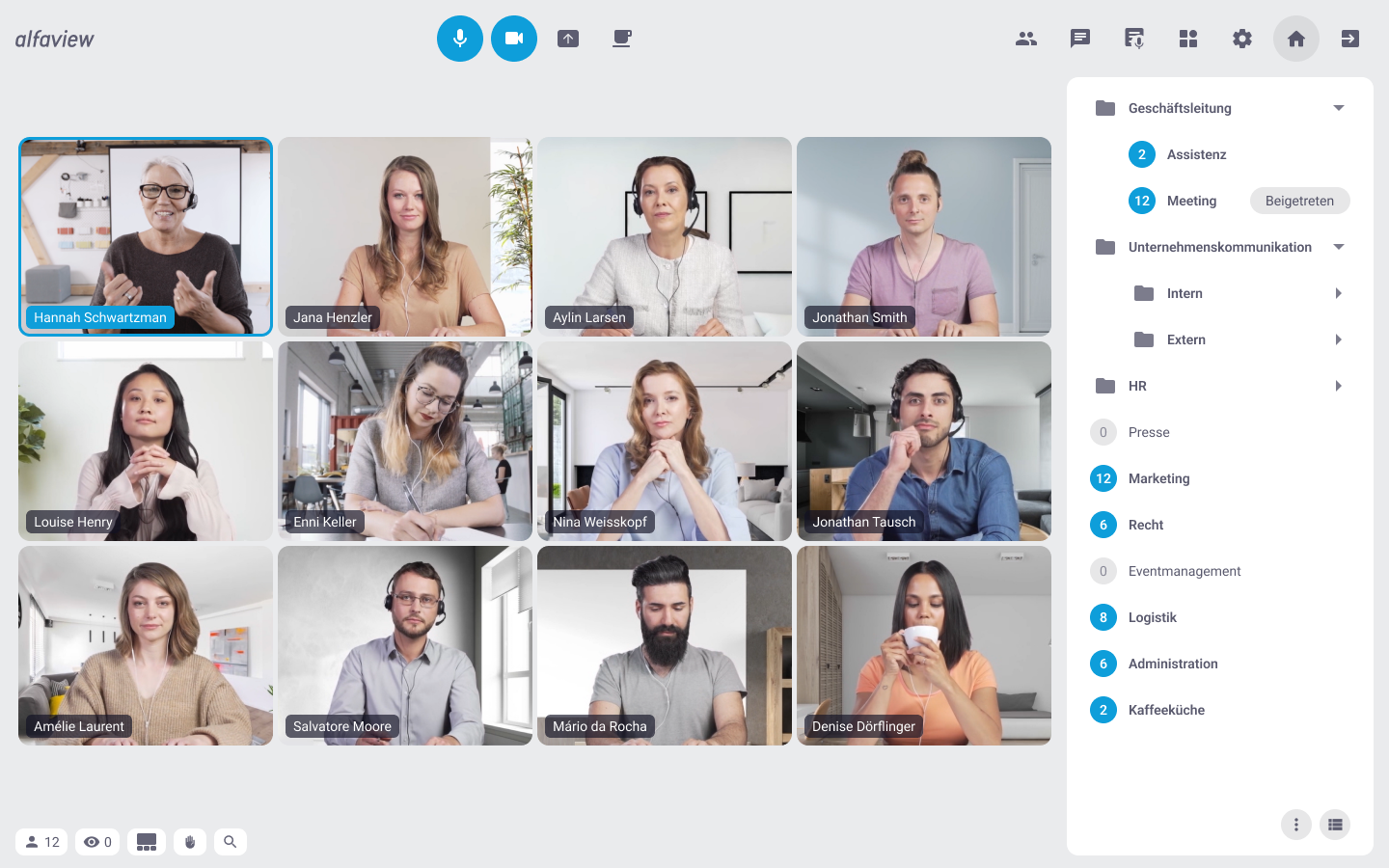
Unlike many video conferencing solutions, which were initially developed as commercial software products, alfaview was created in response to the needs of professional development. From the very beginning, the focus was on how to make educational programs digitally accessible regardless of where people live or their individual circumstances. Step by step, this use case evolved into a video conferencing platform that was later adopted in other fields as well.
Accessibility Considered from the Very Beginning
The commitment to enabling digital participation continues to shape alfaview’s development to this day. For example, following its acquisition of the AI company EML Speech Technology, the company integrated features such as automatic transcription and translation into the platform. Another step followed with the acquisition of Semanux. The company develops technologies that allow software to be controlled through eye movements, gestures, or mouth movements, among other methods.
“People who cannot use their hands can access our digital products—as well as those of other providers—through Semanux’s accessible control applications. This allows users with limited mobility to participate in regular video conferences—something that would otherwise often be impossible,” explains Baum.
The focus on digital inclusion continues to shape the development of alfaview to this day. Accessibility was not added as an afterthought; rather, it was already part of the original use case. From the very beginning, the goal was to enable as many people as possible to access digital educational resources and collaborate.
Competition and Digital Sovereignty
Beyond product development, the company says it is also committed to fair competition in the market for video conferencing solutions. Together with Slack, alfaview filed a complaint with the European Commission against the bundling of Microsoft Teams with Microsoft 365. The European Commission’s decision is intended to contribute to greater freedom of choice and fairer competitive conditions in the market for collaboration and video conferencing solutions.
“For us as a European provider, the complaint filed with the European Commission was a major success,” says Claudia Baum. “The separation of Teams from the Office suite and Microsoft’s far-reaching commitments have strengthened competition and contributed to greater innovation and freedom of choice in the market for video conferencing systems.”
A development in Karlsruhe with European significance
The development of alfaview illustrates how a specific use case in the digital hub of Karlsruhe gave rise to a technology with European significance. Especially against the backdrop of the debate on digital sovereignty, this story highlights the innovation potential inherent in regional technology companies.
Images, unless otherwise noted: alfaview GmbH