
#DigitalMindsKA - the people behind karlsruhe.digital: David Hermanns
The initiative karlsruhe.digital arose with the collaboration of nine expert groups, over 25 institutions, and over 50 ICT companies. Together they pursue the vision for Karlsruhe to become a motor of digitalization – for competitiveness, quality of life and sovereignty and hence be a pioneer with regard to digital topics. a driver of digitalization It pools expert knowledge, promotes networking and deals with topics holistically in order to actively shape the digital future of the city.
Behind them are people. People who are committed, who are passionate about something and who use their time, their ideas and their expertise for precisely this reason. We want to make visible who these people, the digital minds, are. Once a month, we ask digital minds what drives them and what visions they have.
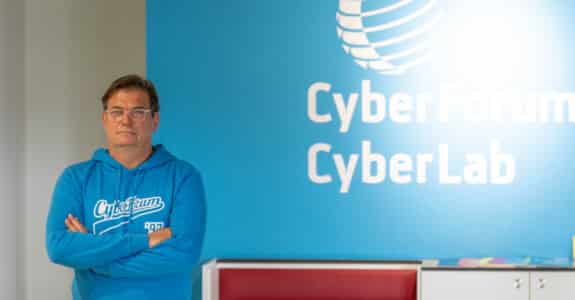
In the fifth part of our series, we visit David Hermanns, Managing Director of the Karlsruhe CyberForum.
It’s one of those early summer days when we make our way to the eastern part of Karlsruhe. The sun is shining, but it’s not too hot yet. A refreshing wind provides the necessary cooling as we walk along Haid-und-Neu-Straße. We pass the FZI Research Center for Information Technology and the Technology Factory, where we catch sight of Hoepfner Castle. The imposing brick building is home to the CyberForum. As the largest regional high-tech.entrepreneur.network. Europe, it connects over 1,300 members of the IT industry. In front of the entrance, we notice a group of young people talking animatedly. Their energy and enthusiasm are infectious and testify to the innovative atmosphere that this place exudes.
Dr. Friedrich Georg Hoepfner, not only managed the private brewery, but also founded the CyberForum 26 years ago as a platform for start-ups, entrepreneurs and research institutions. Last year, he was awarded the Federal Cross of Merit First Class, which recognizes him as a pioneer and driving force behind Germany’s innovation policy.
Today, Hoepfner Burg is not only home to the CyberForum, but also to the CyberLab of the CyberForum. As an IT start-up olympic base, the IT accelerator of the state of Baden-Württemberg, it is one of the first points of contact for start-ups and founders in the state. This year, the CyberForum and the City of Karlsruhe completed another start-up center, the CyberLab SmartProductionPark. This is aimed at start-ups with a focus on “smart production”. The CyberForum now offers founders a total of over 5,400 square meters of space – in the middle of Oststadt, close to the KIT, the FZI, the Fraunhofer IOSB and the Technologiefabrik.
Privately and professionally: connected to Karlsruhe
When we finally enter the castle, the special atmosphere is immediately palpable. Within the historic walls of the castle, which is over 120 years old, we find modern and bright offices. To get to the CyberForum, we go up to the third floor. As we still have some time, we decide against taking the elevator and prefer to use the impressive, light-flooded staircase.
We can already see David Hermanns through the glass front of his office as we register at reception. He immediately beckons us over. Coffee and water are already on the table, so after a quick chat we get straight into our interview. “Let’s start off easy,” we think and ask him what comes to mind first when he hears the word “Karlsruhe”. His answer reveals a man who is deeply connected to the city, both privately and professionally.

Lucky shamrock and
digital location
“As a passionate soccer fan, I naturally think of KSC first. At the same time, I also see Karlsruhe as the center of a lucky cloverleaf of different cultural regions,” Hermanns explains to us and we notice a sparkle in his eyes. “We have the Kraichgau region, the gateway to the Black Forest, the Southern Palatinate and Northern Alsace – all within a radius of 20 kilometers. This diversity is unbeatable in Germany and ensures an incredibly high quality of life,” he enthuses. But there is also a political dimension to Hermann’s relationship with Karlsruhe. “For me, the city is also the cradle of democracy,” he adds. “We have the first German constitution here and a culture that has always been very liberal and tried to rethink society.”
When we hear the word constitution, we immediately think of a point in Hermann’s CV that we stumbled across when preparing for our meeting. Before he became Managing Director of CyberForum in 2007, he studied law and worked as a lawyer for five years. When we ask him about his switch from law to IT, he leans back and smiles: “I actually ended up in a law firm that looked after many IT companies, including one of the largest in Karlsruhe. My boss at the time even wrote the first statutes for DENIC ( German German N sthork I nformation C enter) and we were already supporting start-ups back then.”
From the legal profession to the start-up world
“To take CyberForum to the next level, we needed a management team,” recalls Hermanns. With the then CEO Elmar Buschlinger, a vision for the CyberForum and the experience from his previous job, he decided to quit his job as a lawyer and devote himself entirely to the CyberForum. “We have developed an ambitious plan to take Karlsruhe and the region to a whole new level as a leading-edge cluster in the field of digitalization,” he continues. “And to this day, the ceilings have never been too low for us, we have simply constantly expanded and increased them.” So it’s no wonder that Hermanns is involved with the CyberForum as a co-initiator of the karlsruhe.digital initiative.
His view of a flyer on the subject of recruiting skilled workers. “You only have to look at the statistics. Germany has the highest dependency on STEM professions in Europe. At the same time, we have a huge gap in precisely this area, partly due to demographic change and partly due to a lack of willingness to deal with this topic,” he blurts out.

Recruitment of skilled workers begins at STEM promotion
It was therefore clear very early on that everything had to be done to get young people in particular interested in STEM professions. For example, the CyberForum has helped to launch initiatives such as technika – Karlsruher Technik Initiative. Here, from elementary school to secondary school, over 2,000 children and young people are accompanied in a playful way with STEM topics in working groups every week. Since its foundation, CyberForum has also developed a training initiative, a pool of skilled workers, an academy for further training and a support program aimed specifically at people without a vocational qualification. “Together with the Chamber of Industry and Commerce, we have developed recognition profiles and are using them to bring university dropouts into the primary labor market, for example,” Hermanns explains.
A glance at the clock tells us that the conversation is coming to an end. Hermanns nevertheless offers a short tour of the CyberForum premises. Of course, we gladly accept, because walking is a great way to chat.
“The fact that networking and collaboration work so well in Karlsruhe is of course also due to the size of the city. We have short distances here and people trust each other thanks to our long-standing, good relationships. This means that new projects and activities can be launched virtually on demand. From business and science to administration and culture, everyone works hand in hand. This makes Karlsruhe a city that is able to promote effective and productive collaboration – our so-called “Karlsruhe principle of short distances” – which has ultimately earned it the reputation of being a Germany-wide IT stronghold,” he explains as we walk through the modern open space offices and let our gaze wander over the Karlsruhe skyline.
This is why the karlsruhe.digital initiative is so important. Because the various players can organize themselves here and work strategically with science, business and the city on the future of Karlsruhe as a digital location. “If we join forces, we can compete very well in the national and international competition between locations. For me, Karlsruhe is a city of the future, equipped with all the ingredients to positively shape our future for the people. This has driven us as CyberForum for 26 years to contribute our entrepreneurial and digital expertise and help shape the future,” Hermanns continues enthusiastically.
Family breakfast gives you energy
We realize that we have heard a lot about the CyberForum today and learned a lot about the digital location. Finally, however, we are interested in Hermanns as a private individual. “My day starts with getting up early and having breakfast with my family. That’s important to me, because it gives me the energy and the positive mindset I need for the rest of the day,” he answers us in his usual open manner.
After all, his working day is a busy one and often filled with evening events. “I usually spend two days a week in the office, and the other days I’m on the road. Sometimes I also work from home. Nevertheless, there are always important appointments and meetings in between that I have to respond to flexibly.” He smiles: “If you like, my calendar is just as agile as the IT industry.”
Nevertheless, Hermanns manages to get involved beyond his professional activities – on the executive committee of the Bundesverband IT-Mittelstand e.V. (BITMi), on the Fairantwortung supervisory board, on the board of the KI-Allianz Baden-Württemberg cooperative, as a member of the board of trustees of the Hoepfner Foundation and for many years on the Karlsruhe municipal council. “I believe that you have to get involved in order to bring about change. Everyone can and should contribute to shaping society and democracy.” And when he does want to switch off, he meets up with friends, watches soccer or simply goes straight to the stadium with his sons.
Courageous and open to the future
Before we say goodbye, we have one last question – and look to the future: “What will Karlsruhe look like in 30 years?” Hermann’s answer comes without hesitation: “Karlsruhe will be Germany’s city of the future.” His words testify to optimism and an unshakeable belief in the city’s ability to continue to assert itself as a pioneer of innovation. “This will be the cradle of autonomous driving. Perhaps we will also fly Volocopters to Stuttgart. We will have the best citizen participation platform and so-called smart city solutions and ban private transport from the city center. We will get around with rentable, autonomous vehicles adapted to the individual – or simply enjoy our beautiful city center of the future on foot or by bike. Our quality of life index will be the highest compared to other German cities.”
It describes an open city that boldly faces the challenges of the future and whose citizens have the digital skills they need to succeed in an ever-changing world. “People with digital skills will be the gold of the future,” emphasizes Hermanns. “And Karlsruhe will train them to prepare for the future.” With these thoughts, we leave the office as the setting sun bathes the sky over Karlsruhe in a warm orange. It is the perfect metaphor for the day that is ending and the future that is just appearing on the horizon.