
#DigitalMindsKA - the people behind karlsruhe.digital: Ralf Schneider
The initiative karlsruhe.digital arose with the collaboration of nine expert groups, over 25 institutions, and over 50 ICT companies. Together they pursue the vision for Karlsruhe to become a motor of digitalization – for competitiveness, quality of life and sovereignty and hence be a pioneer with regard to digital topics. a driver of digitalization It pools expert knowledge, promotes networking and deals with topics holistically in order to actively shape the digital future of the city.
And there are people behind it. People who are committed, who are passionate about something and who use their time, their ideas and their expertise for precisely this reason. We want to make visible who these people, the digital minds, are. Once a month, we ask digital minds what drives them and what visions they have.
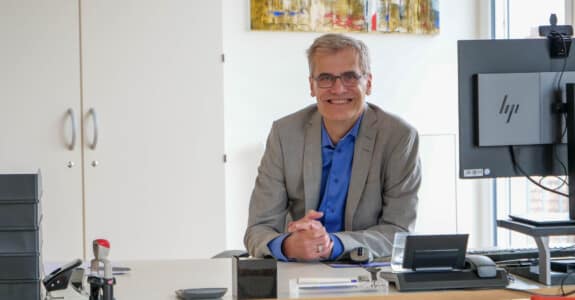
In the fifth part of our series, we visit our steering committee member Ralf Schneider, Managing Director of CONET ISB GmbH and Chairman of the CyberForum in Karlsruhe.
We are late on a sunny Wednesday morning when we enter the grounds of the former Badische Maschinenfabrik in Durlach. Moulds were once produced here using press moulding machines, which explains the name of the street “Zur Gießerei”. In the meantime, new life has been breathed into the site, including the P90 start-up center and the headquarters of Karlsruhe-based CONET ISB GmbH.
And that’s exactly where we have an appointment to meet Ralf Schneider today. He is the Managing Director of CONET ISB GmbH, which develops customized software solutions for public administration and industry. Schneider picks us up personally at the entrance. We go to the fourth floor. That’s where his office is.
While we prepare everything for the interview that is about to follow , he pours us a cup of coffee – and for us, now is the time to find out a little more about the man whose story at CONET ISB GmbH began back in the early 1990s. “I come from a classic working-class family. Since I was 15 years old, I’ve always worked during the vacations , stood on the assembly line and earned extra money,” says Schneider. “I then came to Karlsruhe in 1984 to study industrial engineering at . At the same time, my focus has always been on IT. At the end of my studies at I started writing job applications and an ISB advertisement in the newspaper caught my eye. As the company was just around the corner from me, I thought it was a great opportunity to practise job interviews before introducing myself to big players like SAP . In fact, I never really intended to start there.”
Ralf Schneider: “This is the right place for me”
In the end, however, everything turned out differently. During the job interview, Schneider realized that the job at ISB was exactly what he wanted to do. “I was able to combine what I learned during my studies, namely the development of database-supported software applications, with what I did in my free time at : environmental protection. At that time, the ISB was looking for someone to set up an environmental information system in Rhineland-Palatinate. That was exactly my thing – and I knew I was in the right place.”
In 1991, Schneider became the fifth employee of the company to take up his position as a software developer and consultant. In the years that followed, he was responsible for a wide variety of projects and sales, until he became a member of the Management Board in 2005 and a few years later bought the company together with his former Management Board colleague. ISB has been part of the CONET Group since the beginning of 2022

Due to the beautiful weather, we decide to continue our conversation on the roof terrace, which is directly adjacent to Schneider’s office . From here, you have a phenomenal view of the nearby Turmberg. There is a barbecue in one corner, because in summer the roof terrace is often used for events with the company’s 250 or so employees. Schneider lets his gaze wander and tells us that he grew up in Sauerland , where most of life takes place indoors. “In Karlsruhe, on the other hand, life takes place outside. That was the first thing I noticed when I came here, . The weather here is almost always great with lots of sunshine and every pub already has tables outside in spring. I didn’t know like this before and I wouldn’t want to miss it again.”
The principle of short distances
One topic that is very close to Schneider’s heart is networking: “I have not made many mistakes that I would have made because I have always exchanged ideas with other companies and institutions.” For this reason, he is not only on the board of trustees of the FZI Research Center for Information Technology, but also on the board of the Karlsruhe CyberForum. “We need to attract even more IT specialists to Karlsruhe and keep them here. The CyberForum with its more than 1,200 members makes an important contribution to this. Whether job exchanges, programs for university dropouts, further training opportunities, coaching or mentoring – with our Hightech.Unternehmer.Netzwerk. we support companies in all phases of development and network the IT region of Karlsruhe. For me, it is particularly important that a globally renowned ecosystem with many IT specialists, research institutions, start-ups and established companies is created here.”
ISB relies on a hybrid working model
In this context, Schneider also emphasizes the importance of the Karlsruhe principle of short distances for the location, which is reflected in the karlsruhe.digital initiative. “I believe that digitalization can only work regionally if all stakeholders pull together. Although many cities claim to do this, I don’t know of any city apart from Karlsruhe, where it really works. Business, science and administration work hand in hand here. People exchange ideas and help each other. The is particularly noticeable in tenders, for which you can get all the necessary stakeholders on board within a very short time because everyone trusts each other.”
It’s getting a little too hot on the roof terrace, which is why Schneider invites us to take a short tour of the ISB premises. However, considering that a total of 250 employees work here, the offices seem rather deserted. When Schneider notices our questioning look, he explains that ISB now relies on a hybrid working model and that employees are only in the office two days a week. They decide for themselves on which days. “And yet, even in the age of digitalization, it’s still important to meet in person at the office from time to time.”
Digital change must remain understandable
A good keyword. How does someone who has been working in IT for almost four decades assess the path we have taken towards digitalization? “It’s clear that no company can avoid digitalization anymore. The opportunity to save costs, optimize processes and tap into new business and customer areas. All of this can only be achieved through digitalization,” explains Schneider. “And public administration also needs to focus more on the digital transformation.”
Schneider is proud of the path Karlsruhe has taken so far, a city that has already won several awards for its innovative strength. But he also knows: “Success will largely depend on whether we manage to take everyone with us on this journey. There are always people who are critical of this development,” he says. “They are afraid of being overrun by the wave and losing their jobs. We have to make them understand what is going on and how they can shape the change themselves.”

Local players at one table
This is why initiatives such as karlsruhe.digital, of which he himself is a steering committee member, are so important to Schneider: “On the one hand, they help to bring together local players from science, business, culture and administration and thus strengthen the region as a digital location. On the other hand, they also make the digital transformation visible and tangible for the city’s population with events such as the Colourful Night of Digitalization.” This look behind the scenes and the resulting transparency are important in order to address people’s fears and concerns at eye level.
We are slowly but surely approaching the end of our appointment, but Schneider still wants to show us something. As we walk through the building, there is still time for some small talk. He tells us that he is an early riser and is in the office almost every day at half past seven in the morning. Partly until 7 pm. In between, there are lots of meetings and customer appointments outside the office. And afterwards? “Often networking events in the evening. And yet I still manage to switch off in my private life. I love hiking and running marathons. Or I can sit back and listen to music.”
We have obviously reached our destination. Schneider opens a door and suddenly we are standing in a kindergarten. He looks at our astonishment and smiles: “You know, we were actually the first company in Baden-Württemberg to have our own company kindergarten. And it still exists today. I’m delighted that we can offer our employees this service and support families in this way.” We watch for a moment as the children run around happily and wonder what we, equipped with laptops and cameras, are actually doing here. Then it’s time to go. Schneider takes us to the exit and we stroll out into the parking lot, where – as is so often the case in Karlsruhe – the sun is still shining.