
#DigitalMindsKA - the people behind karlsruhe.digital: Jan Wiesenberger
The initiative karlsruhe.digital arose with the collaboration of nine expert groups, over 25 institutions, and over 50 ICT companies. Together they pursue the vision for Karlsruhe to become a motor of digitalization – for competitiveness, quality of life and sovereignty and hence be a pioneer with regard to digital topics. a driver of digitalization It pools expert knowledge, promotes networking and deals with topics holistically in order to actively shape the digital future of the city.
Behind them are people. People who are committed, who are passionate about something and who use their time, their ideas and their expertise for precisely this reason. We want to make visible who these people, the digital minds, are. Once a month, we ask the Digital Minds what drives them and what visions they have.
In the fourth part of our series, we visit Jan Wiesenberger, CEO of the Karlsruhe FZI Research Center for Information Technology and head of the innovation transfer working group at karlsruhe.digital.
We normally use the streetcar to get to our appointments in the middle of winter. But today we are out and about on our bikes, sunglasses on our noses. Although it’s only February, the sun is shining in our faces in spring-like temperatures. We pass Hoepfner Burg, where CyberForum and CyberLab are based – and in the distance we can already see the hustle and bustle on the grounds of the Karlsruhe FZI Research Center for Information Technology .
We didn’t choose just any day for our meeting with Jan Wiesenberger, but the FZI Open House 2023. For one day, the FZI opens its doors to visitors under the motto “Innovations for societal challenges”, who can experience the transfer of technology and knowledge at first hand using current research projects.
When we enter the FZI House of Living Labs at 11 a.m., Wiesenberger is already there to meet us. He has just opened the FZI Open House 2023 with a speech in front of a full house , and now he takes time for us. But first we have to change sides of the street, as his office is located opposite in the FZI’s main building .
Karlsruhe – IT stronghold with quality of life
We take a seat in a spacious conference room. While Wiesenberger prepares us an espresso, we start the interview with the question we ask all digital minds: The first thought when it comes to “Karlsruhe”.
He smiles, puts the espresso down next to our notepad, goes to the window and lets a few rays of sunshine flash through the blinds: “To hot summers! Many people would probably respond with classic terms such as IT stronghold, residential city or city of law . But when I came to Karlsruhe as a young student, I immediately noticed how incredibly warm and beautiful the summers are in the Rhine Valley. My first summer here was almost like a vacation. This memory is engraved in my mind, and it comes up again and again when I hear the word Karlsruhe.”
The 45-year-old studied industrial engineering at the University of Karlsruhe, now the Karlsruhe Institute of Technology (KIT). After graduating, he initially worked as a research assistant and division manager in the Software Engineering department at the FZI, originally with the aim of obtaining a doctorate. Instead, however, he held numerous other positions and roles within the FZI until he was appointed to the Executive Board at the end of 2014.
“Since I joined the FZI in 2004 as a research associate , a lot has changed, especially with regard to the digital transformation . And by that I don’t just mean the technical possibilities, but also the impact of technology on society, especially on our private and professional lives. I can see that very clearly in the students at the FZI. The availability of information and media use are now completely different,” Wiesenberger tells us.

New technologies require adaptation, transfer and participation
However, he is increasingly observing an imbalance. On the one hand, there is the extreme speed at which new innovations and technologies are produced. A speed, which overtaxes parts of society. On the other hand, many things are still extremely slow. Wiesenberger smiles: “Considering that we are an IT institute, we still have far too much paper, which is then sent around by internal mail at .” Nevertheless, modern forms of work such as home office and remote work are now also part of everyday life at the FZI. “I keep hearing that managers are bringing their employees back into the office because they are afraid of losing control I, on the other hand, am of the opinion that excessive control does not change anything at all. Those who enjoy working in the office also do so from home . And vice versa. That is why we rely on a culture of trust. And that works very well.”
Trust and cooperation at eye level are also the focus of the karlsruhe.digital initiative, where Wiesenberger heads the innovation transfer working group. The focus here is on the question of how business, science, culture and administration can create an environment within Karlsruhe that not only generates innovations, but also develops them into market-ready products and services. “The much-cited Karlsruhe principle of short distances plays an important role here,” emphasizes Wiesenberger. “We all know each other here and work hand in hand. If a new opportunity arises unexpectedly, we can get things off the ground quickly and unbureaucratically. This is a huge advantage over other locations and contributes greatly to the fact that innovation and innovation transfer have now become the core brand of the fan-shaped city.”
However, it is also important to think outside the box. Since 2011, the FZI has therefore maintained a branch office in Berlin, a kind of showcase for Karlsruhe as a digital location, which enables cooperation with federal ministries as well as important associations and organizations. “Everyone benefits from the resulting exchange. Although people like to pretend that Karlsruhe and Berlin are in competition as digital and start-up locations, this is not the case,” explains Wiesenberger. “In the German capital, the focus is on B2C innovations, while here in Karlsruhe we focus on the B2B sector and cooperation with companies from the production industry.”
Experience the transfer of technology and knowledge live
It all sounds very theoretical – and that’s exactly why we decide to continue our conversation with a tour of the site of the FZI House of Living Labs, where you can experience the transfer of technology and knowledge just mentioned live today at the open house .
For Wiesenberger, this look behind the scenes, which events such as the Colourful Night of Digitalization also make possible, is extremely important. “Above all, it’s about visibility and participation. The digital transformation is a process for society as a whole and can only succeed if we manage to get everyone on board.” He pulls out his smartphone and points to an app icon: “I was involved in the development of the Karlsruhe.app from the very beginning, for example, because I think it’s the perfect tool to get citizens on board with digitalization. On the one hand, it provides information and, in the long term, services. On the other hand, it offers citizens the opportunity to participate in the further development of the city. This participation is important so that citizens grow closer together in a digital world and identify with their city.”
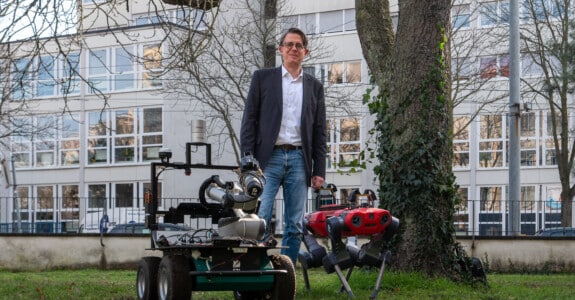
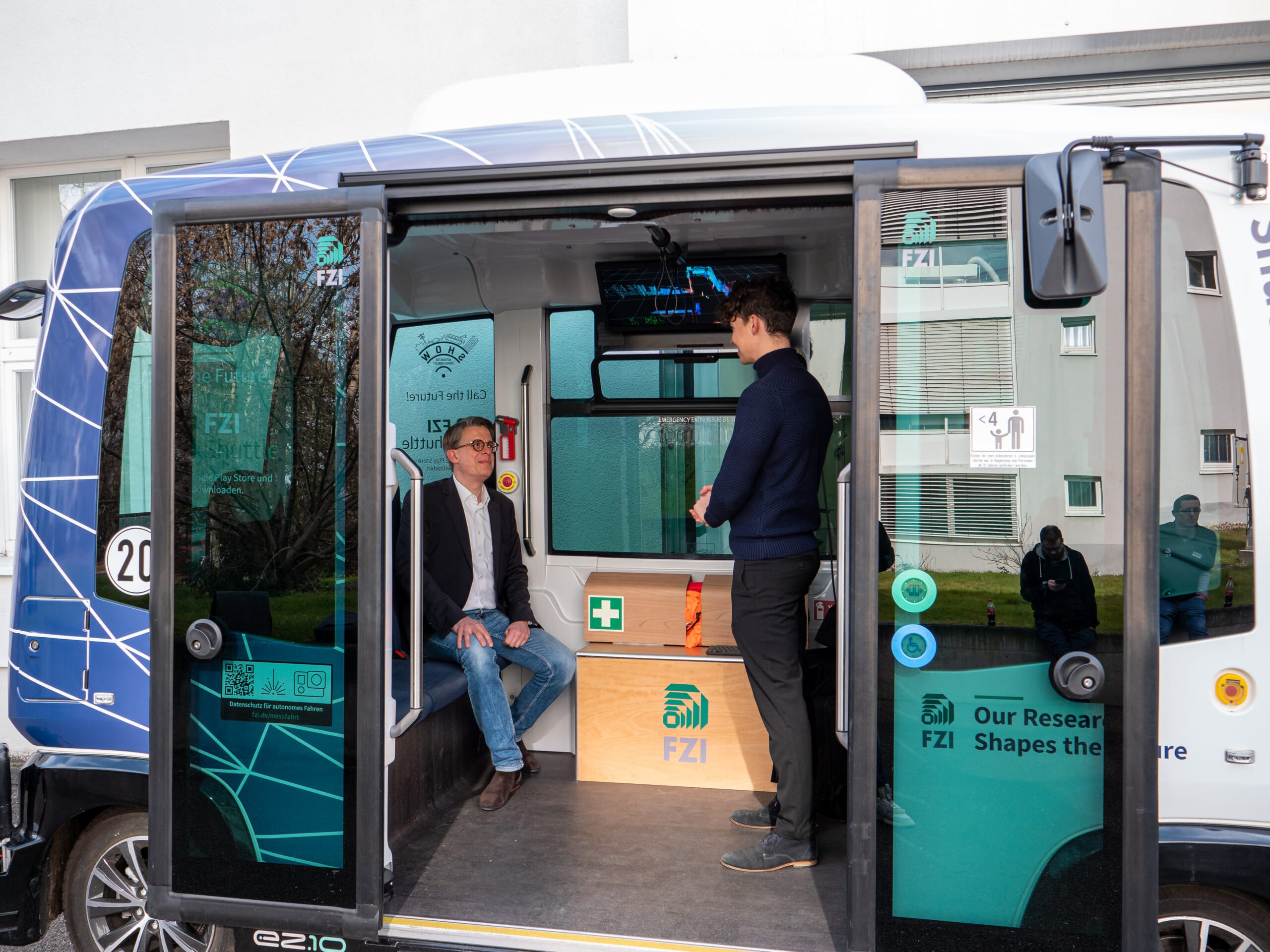
As we look up from our smartphones, a robot that looks a lot like a dog suddenly comes running towards us. Behind him, another robot with a long gripper arm makes its rounds on the lawn of the FZI House of Living Labs. Further back, some developers discuss the potential of autonomous vehicles with interested guests and explain the technologies required for this. Also featured is one of the automated mini-buses, which have been operating in the Weiherfeld-Dammerstock test area again since December and can be booked for a free ride via an app if required.
Future technology artificial intelligence – opportunities from Karlsruhe
Much of what we are seeing today at the FZI Open House is only possible thanks to the use of artificial intelligence (AI). “AI applications are already present in many people’s everyday lives, sometimes without them even knowing it. AI has the potential to improve our lives in many areas. I would even go so far as to speak of a turning point,” explains Wiesenberger. He pauses briefly and lets his gaze wander over the grounds. With a slightly more thoughtful expression, he continues: “Nevertheless, AI must not become a black box that exacerbates the drifting apart of our society. We need to empower everyone to understand the technology, but also to be able to assess its dangers and limitations. Only then can society use AI applications sensibly and benefit from them.”
In other words: Neither the field of artificial intelligence nor digitalization as a whole should be viewed from a singular technical perspective – and this is precisely where Wiesenberger sees the great strength of Karlsruhe as a digital location: “Due to the permanent exchange between business, science, culture and administration, we always look at innovations and new technologies from a wide variety of perspectives and can thus develop them further for the benefit of the general public.”
The Digital Hub Karlsruhe, which is supported by the FZI among others, supports start-ups in the field of AI with mentoring, coaching and the provision of workspaces. The AI Radar also provides an overview of the latest trends and fields of application for AI. Karlsruhe will also establish the Baden-Württemberg AI Alliance with partners in 2023 with the aim of creating a center and ecosystem for artificial intelligence for Baden-Württemberg that is competitive and visible throughout Europe and internationally.
In 30 years, Karlsruhe will…
And that brings us almost to the end of our conversation. Finally, Wiesenberger invites us to a small snack at one of the numerous food trucks. We use the remaining time to find out what someone who is surrounded by robots, AI and other digital innovations all day long does in their free time . Wiesenberger tells us that he is a passionate DIY enthusiast, hobbyist and cyclist. “However, I walk to work as I only live ten minutes away from the FZI at . I haven’t had a car for a long time, after I realized at some point that my old one had only been in the underground car park for three years.”
Before we say goodbye, we have one final question for all digital minds: “Let’s take a look into the future: In 30 years, Karlsruhe will be…”. He grins and looks up at the bright blue sky: “In 30 years’ time, there will still be very beautiful summers in Karlsruhe.”
Cover picture: Netzoptiomisten