
Minimal Carbon Internet was the result of suffering - an interview with Michael Saup
The resource consumption of a blockchain transaction is roughly equivalent to that of an iPhone. Every single search query, every streamed song or video and every type of cloud computing, carried out billions of times all over the world, is responsible for an ever-increasing global demand for electricity – and therefore also for rising CO2 emissions. This hasn’t just been a problem since the energy crisis, but solutions are needed now.
Sustainability is above all a cultural challenge in which old patterns and habits need to be questioned and unfamiliar things need to be embraced. Changes are addressed very differently through art and culture than through science. In this respect, an active and diverse arts and culture scene that gets involved is an important driver for transformation processes.
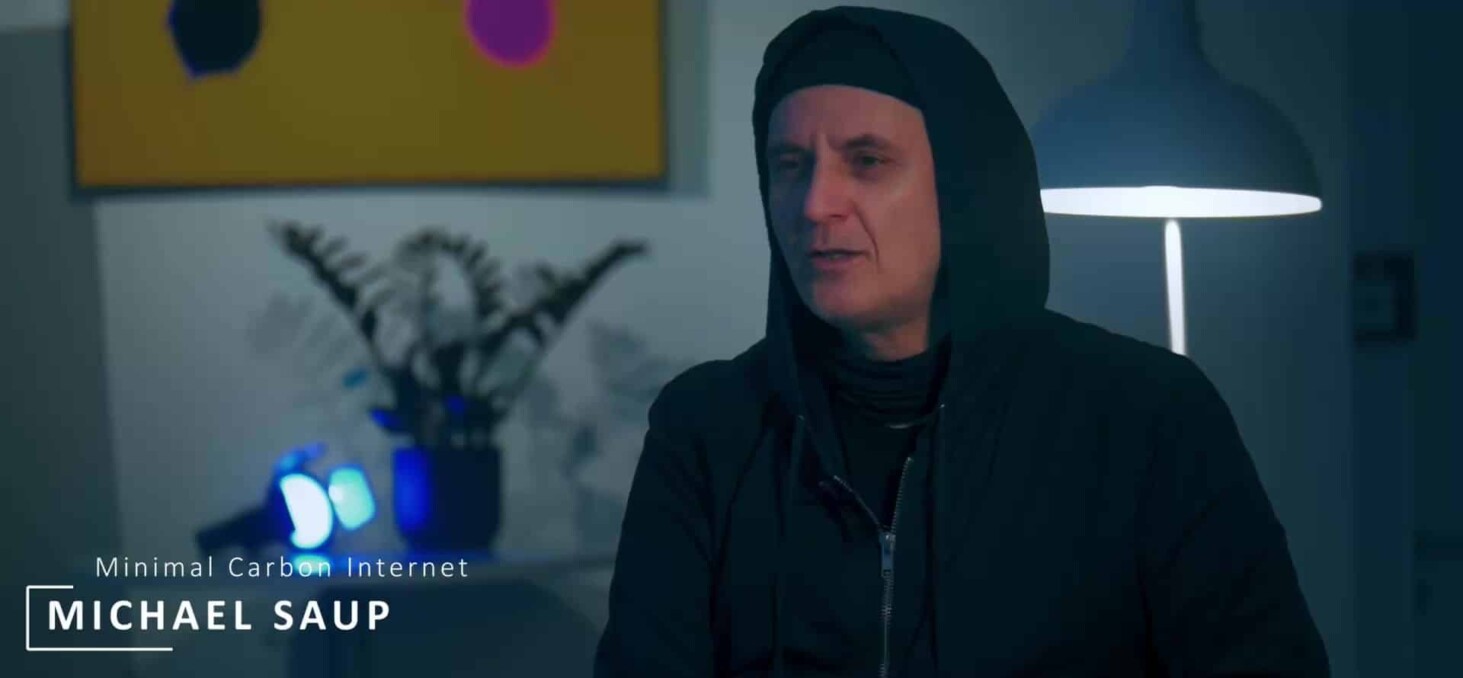
The karlsruhe.digital initiative got involved and took an artistic approach: Minimal Carbon Site is the result. Media artist and computer scientist Michael Saup explains the project in an interview.
For further reading:
You live in Berlin, what connects you to Karlsruhe?
I have a professional connection with Karlsruhe. I was a professor at Hochschule für Gestaltung at the ZKM, so it is fascinating for me to walk through the city and see how it has changed.
Explain the “Minimal Carbon Internet” project
Minimal Carbon Internet was the result of suffering. I remembered a conversation with the director of a research institute in Berlin. I showed how much energy the Internet consumes in the form of carbon, in the shape of a pyramid. He said: “That’s suffering pressure!” and I said “No, not really, that’s logic!” Information requires energy. As it turns out, information requires a lot of energy. So I thought: “Okay, then take a step and offer a solution!”
Why the clone of karlsruhe.digital? What do you expect?
karlsruhe.digital is the prototype, so to speak. How much energy can you save? I thought that might be half, but no, it’s a factor of 20, i.e. 95 percent! So you could switch off a lot of power plants worldwide. You only have to look at what kind of servers most sites run on: Coal-fired servers, which don’t leave a good footprint on our society. That’s why shows how much energy is saved on the website, because if we don’t do this, the improvement in sustainability remains hidden.
How does the “minimal carbon site” differ from the ideas/methods of sustainable web design?
There are currently very few sustainable websites. Mainly websites are optimized to make them static and therefore faster. To improve the SEO ranking of . But I can just as well argue: “I’m not primarily concerned with the SEO ranking, I’m primarily concerned with sustainability!”
What’s next for “Minimal Carbon Internet”?
Ideally, we would reduce the consumption of all websites and ensure that the whole world no longer relies on fossil fuels. It is not the fuel that is fossil here! Our thoughts are fossil! And as long as we burn everything up here, there will be no room in the world for a new kind of terrestrial intelligence. The Internet will never find a flowering of the mind and peace in society. That is my prediction.