
Mobility researcher Christoph Stiller: The future of autonomous driving
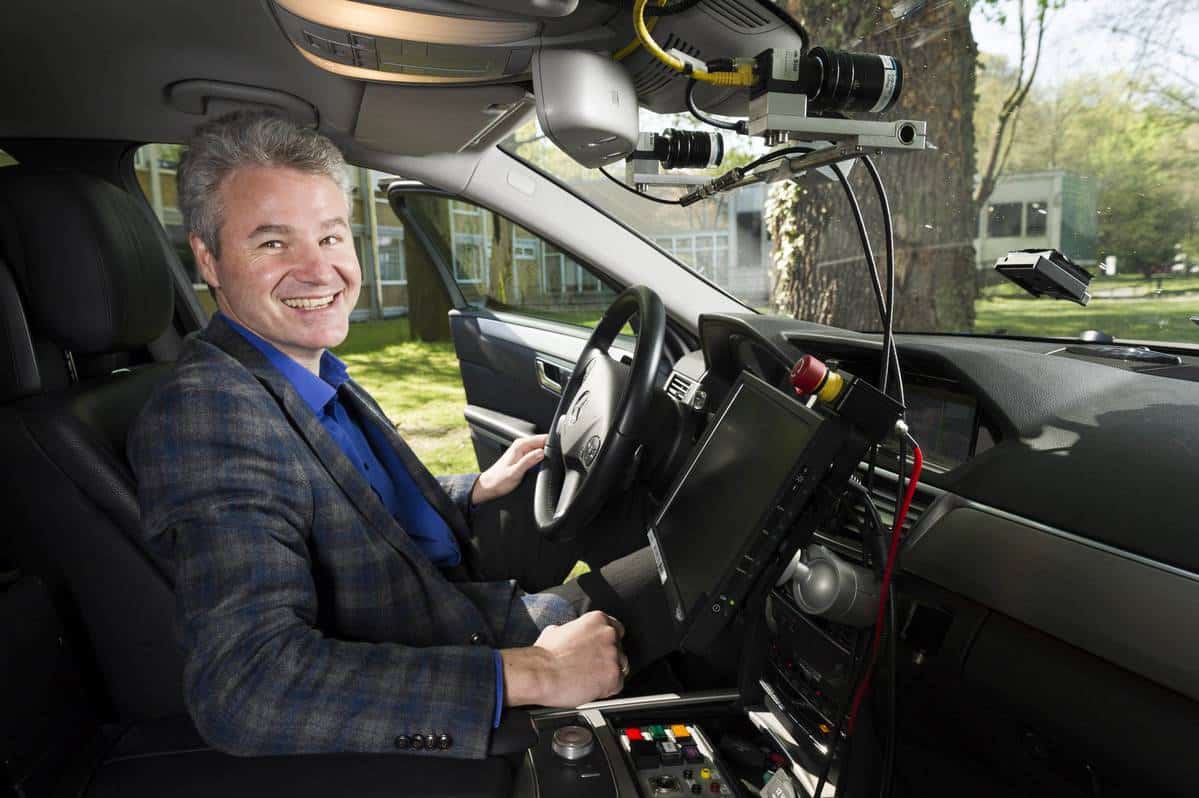
Mobility researcher Christoph Stiller is head of the Institute for Measurement and Control Technology at the Karlsruhe Institute of Technology (KIT) and one of the directors of the Research Center for Information Technology (FZI). In an interview with karlsruhe.digital, the electrical engineer talks about the future of autonomous driving.
karlsruhe.digital: How long will it be before the first driverless autonomous cars are on Germany’s roads?
Christoph Stiller: The fully driverless car is the end of the road for autonomous driving. It will probably be another 15 years before it is ready on all roads. However, the first autonomous cars will be on the roads in just one year’s time.
The sensor technology for autonomous assistance systems already exists. So what are the biggest challenges at the moment?
Stiller: There are also still technical problems in the development of autonomous driving. Ultimately, the technology has to be designed in such a way that safety is guaranteed in all situations. Proving safety also requires a discussion with the public. However, there will still not be complete safety on the roads in the future. But there will be far fewer accidents than with cars driven by humans.
Sovereignty at the wheel
Germany is a driver’s country and one of the few countries without a speed limit. Are Germans even prepared to hand over their sovereignty at the wheel to machines?
Stiller: That’s a good question. But it will inevitably happen. After all, it is a gradual development. First of all, some luxury cars will be autonomous and then this development will gradually migrate to the lower classes. At some point, everyone will be able to decide for themselves whether they want to sit behind the wheel on boring highway journeys. Or whether you simply sit down and let it drive, just like on a train. Of course, nobody can be forced to do this. But many people will appreciate the convenience and use the time gained in other ways.
…and what will happen next?
Stiller: …if vehicles drive more safely and reliably than people in all situations, we will have a new discussion. Namely, whether people should be allowed to drive at all. Should we allow a person to run over a child? Or should technology take control in critical situations?
Would this then be a counterpart to the ABS anti-lock braking system?
Stiller: In principle, yes. The difference, however, is that ABS only kicks in when the brakes are applied. The actual action is therefore initiated by the driver. With autonomous safety systems, the car takes control after a warning from the sensor systems.

Mobility transition and framework conditions
Is autonomous driving actually also an opportunity to drive forward the mobility transition and get more electric cars on the road?
Stiller: Yes and no. There are still two developments running parallel to each other. This is also a challenge for the automotive industry. In the future, more electric cars will certainly drive autonomously. But drive technology and autonomous driving are still two different fields of development.
Is the legal framework for autonomous driving even in place in Germany? Daimler is known to be conducting trials with autonomous truck convoys in the USA due to the legal hurdles on German highways .
Stiller: Federalism and the distribution of responsibility among many different ministries are certainly not conducive. But politicians want to support the industry and create the framework conditions. The main difficulty will probably be creating the necessary admission criteria. Anyone can get a driver’s license these days. But there are still no guidelines on how to get an automated vehicle on the road. Another problem area is data protection. After all, an autonomous vehicle has to recognize pedestrians and this is only possible through a thorough analysis of the data. However, it is not legal in many European countries to store images of autonomous vehicles and use them for the further development of safety systems. In the USA, on the other hand, it is a legal service.