
#DigiWomenKA: Christine Groß-Herick – Digital Transformation with a Human Touch
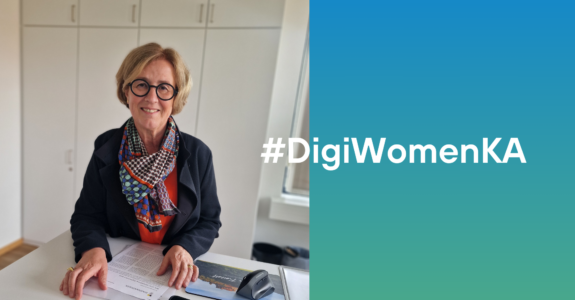
When I walk into the Employment Agency in Karlsruhe one summer morning, I’m stopped right at the entrance. “Where do you have an appointment?” the security guard asks me. Only after I show him my email correspondence with Christine Groß-Herick does the door open. A short time later, the Chair of the Executive Board of the Karlsruhe-Rastatt Employment Agency, along with her press spokesperson Jessica Beiner, welcomes me into her office. In response to my joking remark that she’s obviously well guarded, she replies with a smile: The security staff is primarily there to quickly direct visitors to the right place.
That first impression fits well with a topic that shapes our conversation: How can digital transformation succeed in an organization with more than 700 employees that interacts with thousands of people every day?
Christine Groß-Herick has been Chair of the Executive Board of the Karlsruhe-Rastatt Employment Agency since November 2024. A lawyer by training, she brings many years of leadership experience to the role: She previously headed the Landau Employment Agency for 16 years. She has lived in Karlsruhe since the late 1990s. Today, her responsibilities include overseeing the agency’s digital transformation and supporting both companies and employees as they navigate changes in the labor market.
Digitalization is more than just new software
For Christine Groß-Herick, digital transformation doesn’t start with new technology, but with the people who use it.
The Federal Employment Agency is currently working on introducing its own AI system. It functions similarly to ChatGPT, but is based on European data protection standards and is trained exclusively using the agency’s own data. In the future, it is intended to support employees in areas such as counseling sessions, funding decisions, and knowledge management.
For Christine Groß-Herick, however, implementing such a system is not merely a technical task. Digitalization is not viewed as a purely IT project, but rather as an organizational change that requires the active involvement of employees. That is why the Federal Employment Agency relies on digital ambassadors in the various departments, short digital learning modules—so-called “learning nuggets”—and cultural workshops that create space for exchange and active participation.
“No one can do anything wrong here,” says Christine Groß-Herick. “We’re not talking about eliminating positions, but about freeing up capacity for the people who need personalized counseling.”
Human-Friendly Automation
Under the guiding principle of “Human-Friendly Automation,” the Federal Employment Agency aims to consistently further develop digital processes without losing sight of people.
“We want to become Europe’s most advanced digital service provider,” says Christine Groß-Herick.
New AI applications will first be tested at an Experience Center in Nuremberg and then gradually integrated into existing processes. Humanity, empathy, and legal certainty will continue to form the foundation of our work in the future.
Digitization is meant to lighten the load, not replace people
In the future, routine tasks are to be automated to a greater extent so that more time can be devoted to personalized counseling. Especially in light of demographic change, Christine Groß-Herick sees this as a key priority. According to its own figures, the Federal Employment Agency will lose approximately 40,000 employees by 2032.
“It’s almost impossible to recruit people for that,” she says.
Repetitive tasks should therefore increasingly be handled by AI and automation. The Federal Employment Agency’s mission remains unchanged: “Our mission is clear: to bring people and work together—in every situation.”
Digitalization has long been part of everyday work life. Applications for unemployment benefits or short-time work benefits can now be submitted and processed entirely online. Applicants can track the status of their applications online, and an AI-powered chatbot assists with initial questions and helps them fill out forms. At the same time, the Federal Employment Agency relies on its own AI platform hosted in Europe and is investing in cybersecurity—including a 24/7 security center and regular cybersecurity awareness training for employees.