
#DigitalMindsKA - the people behind karlsruhe.digital: Marion A. Weissenberger-Eibl
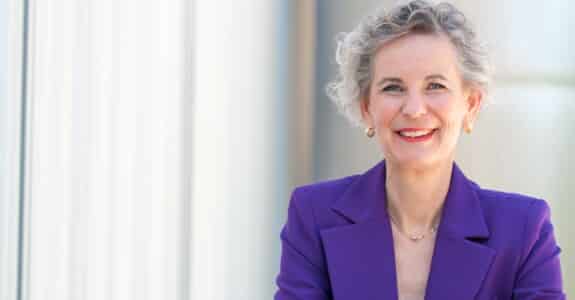
The initiative karlsruhe.digital arose with the collaboration of nine expert groups, over 25 institutions, and over 50 ICT companies. Together they pursue the vision for Karlsruhe to become a motor of digitalization – for competitiveness, quality of life and sovereignty and hence be a pioneer with regard to digital topics. a driver of digitalization It pools expert knowledge, promotes networking and addresses issues holistically in order to actively shape the digital future of the city.
And behind it all are people. People who are committed, who are passionate about something and who use their time, their ideas and their expertise for precisely this reason. We want to make visible who these people, the digital minds, are. Once a month, we ask the Digital Minds what drives them and what visions they have.
In the seventh part of our series, we visit Marion A. Weissenberger-Eibl, Director of the Fraunhofer Institute for Systems and Innovation Research ISI in Karlsruhe.
The morning in Karlsruhe is clear and fresh as we make our way to the Fraunhofer Institute for Systems and Innovation Research ISI to meet Marion Weissenberger-Eibl. The ISI is located in the Waldstadt district, surrounded by nature and countless trees – and for a brief moment, the hustle and bustle of everyday life recedes into the distance. The nearby Hardtwald forest provides a picturesque backdrop that invites you to linger. The chirping of birds mingles with the distant laughter of children letting off steam in the sports park and cheering each other on. We take a deep breath – and then continue on our way.
Once we arrive at the Fraunhofer ISI, we go to the second floor, where Marion Weissenberger-Eibl’s corner office is located. In the secretary’s office we are warmly welcomed by Ms. Hoffmann, the institute director’s assistant. Or as she will later call her: “the soul and at the same time the ‘hub’ to the outside and inside.”
Weissenberger-Eibl is already waiting for us because, as we realized when we made the appointment in advance, her time is short and her schedule is full. So, after a brief greeting and the question of what she thinks of first when she hears “Karlsruhe”, we get straight into the conversation.
She leans back with a smile and then talks about the city that is so closely linked to her heart and her work: “I think first of ideas and the spirit of innovation,” she begins. “You can really feel the mixture of culture and tradition on the one hand and scientific curiosity on the other in the streets of the city.” She goes on to talk about the Karlsruhe Institute of Technology (KIT), the scientific heart of the city, and how it is complemented by other universities and research institutes. “We at Fraunhofer ISI and my team at the chair are in close contact with the students,” explains Weissenberger-Eibl. The interdisciplinary and transdisciplinary exchange that she describes is central to finding scientifically sound, innovative approaches.
Karlsruhe – a digital location for working and living
“The city is also very keen to engage with its citizens,” she emphasizes. The importance of dialog between science, technology and the public is a central theme in her remarks – a key to understanding fears, getting to know needs and creating acceptance for new technologies.
“In addition, the socio-cultural life in Karlsruhe is pulsating. Epochal architectural styles characterize the Karlsruhe cityscape, as does the connection to the green oasis of the Karlsruhe Hardtwald. Classical museums and galleries are complemented by the unique and innovative Center for Art and Media ZKM. This diversity of offerings reflects the spirit of the city.”
Suddenly there’s a knock at the door and Mrs. Hoffmann brings us in a cup of freshly brewed, wonderfully fragrant coffee. As we take a sip, our gaze wanders through the light-flooded office, past an impressive collection of orchids, and we wonder whether Marion A. Weissenberger-Eibl has always had the enthusiasm for science and innovation that she radiates when talking to us.
Curiosity, courage and a willingness to take risks
“As a child, I knew that I wanted to work in a profession where I could be creative and work with people,” she begins. The importance of working with her hands, creating something and trying out new things, always in community with others, was crucial for her from the very beginning. “Dedicating myself to one thing alone doesn’t fulfill me.” Her training as a clothing tailor and subsequent studies in clothing technology were steps on a path that was characterized by both creative passion and a strong strategic understanding. “What fascinates me about the fashion and textile industry is that it is creative on the one hand, but also very strategic on the other,” explains Weissenberger-Eibl. After gaining a foothold in the fashion industry, her studies in business administration and her doctorate at the Technical University of Munich sparked her interest in economic issues. Her decision to habilitate at the Faculty of Economics marked another important step in her career.
“Curiosity, courage and a willingness to take risks,” Weissenberger-Eibl lists when describing the character traits that have accompanied her throughout her life. These traits still drive her today in her quest to expand her skills, to know and experience more. “It has always been my motivation to get to know other industries and learn from them.” In her role as Director of the Fraunhofer Institute for Systems and Innovation Research ISI and holder of the Chair of Innovation and Technology Management iTM at the Institute for Entrepreneurship, Technology Management and Innovation (ENTECHNON) at the Karlsruhe Institute of Technology (KIT), she has the opportunity to do this on a daily basis.
Karlsruhe plays a pioneering role in cooperation throughout Germany
In our conversation, she repeatedly emphasizes the importance of the exchange with the public: “We don’t want to obtain the scientific findings from our research projects for the drawer or the ivory tower, but also to prepare them for society. Because a comprehensive transformation, as is currently necessary, can only succeed if we get all social stakeholders on board.” Permanent cooperation between business, science, administration and culture, in which Karlsruhe plays a pioneering role throughout Germany, is also fundamental for Weissenberger-Eibl. “Digitalization can be an important tool for overcoming the numerous challenges of our time. But for digital technologies to diffuse even further, we need cooperation between business, science and administration. The city of Karlsruhe can develop and offer appropriate formats for this on the one hand and network with other cities and municipalities on the other to learn from each other.” It is particularly important to her that people help develop digital solutions. This is the only way to keep the focus on people – and to ensure fair digital participation combined with a higher quality of life for everyone.
Basic principle of success
And that is exactly what Weissenberger-Eibl is committed to. So successfully, in fact, that she has repeatedly been named one of the 100 most influential women in German business. “For me, success is when I succeed in triggering progress – in other organizations or individuals or groups of people,” she explains with a mixture of modesty and determination.
She talks about how she enjoys introducing new aspects to discussions and issues and seeing how these are not only discussed but also implemented. “This basic principle of success was already true for me in the past and hasn’t changed to this day,” she adds. “A fascination for the new is a quality that I’ve carried with me my whole life,” she says. Her courage, especially in the early days, helped her to stand on her own two feet and fight against resistance.
She particularly emphasizes her creativity and openness to unfamiliar and interdisciplinary ways of thinking. “I find it easy to quickly engage with different perspectives,” she explains. This ability to recognize potential added value and successfully implement elements in practice has had a significant impact on her.
Courage to fail and to carry on
Weissenberger-Eibl also talks about the importance of being able to deal with adversity and resistance and being pragmatic: “Fortunately, there are more and more female professors and women in high economic and political positions. Overall, however, I still see a lot of potential. For example, if we uncompromisingly align laws, funding and values at national level equally to all genders, this can also have a positive impact on the proportion of women in the field of innovation and technology. The Scandinavian countries are leading the way here.”
For Marion A. Weissenberger-Eibl, events such as the Digital Female Leader Awards, which were presented in Karlsruhe in the fall, also make a significant contribution to the visibility of women in digital professions. She reflects on how such events can inspire and motivate women. “Marie Curie, for example, inspired me as a researcher in an environment in which it was not exactly common to be a woman and achieve something,” she says.
Women need networks
For this reason, she is also pleased that Karlsruhe in particular fulfills the requirements to become a digital female leader hotspot. She advises young women not to underestimate networking and not to be afraid of being controversial or expressing an unpopular opinion. “Valuable ideas can emerge precisely when they are developed outside of convention,” she adds. However, in order to establish itself as a hotspot, appropriate framework conditions must also be created, such as good childcare and leisure facilities and attractive schools.
It is fascinating to listen to Weissenberger-Eibl speak with such conviction. However, when we look at the clock, we realize that our appointment will soon be over. We still have so many questions, but decide to finish by finding out a little more about the everyday life and private life of the institute director.
No two days are the same
“I don’t have a day-to-day job in the true sense of the word,” she begins. Her work as an engineer and business economist with a focus on the development conditions and effects of innovations entails a variety of tasks. She describes her working day as being characterized by intensive exchange within the team. “Our team is characterized by interdisciplinarity,” she explains, highlighting how her team benefits from expertise from a wide range of fields. The exchange of ideas throughout the institute, whether in the form of committees, strategy days or the doctoral program, is of central importance to her.
Weissenberger-Eibl also emphasizes the importance of regular participation in events such as lectures and conferences: “Such an exchange of information helps us to get a differentiated and holistic picture”. Her activities on political, economic and scientific committees, her advisory work and her teaching at the Karlsruhe Institute of Technology are other important aspects of her professional life.
Hiking as a balance
When asked about routines or hobbies that help her to switch off, she talks about her passion for hiking. “Hiking is very important to me,” she says. The fascination for untouched natural landscapes, switching off and relaxing in nature, gathering energy and new ideas – she finds all of this while hiking. “I come up with new ideas and visions when I catch my breath during breaks from hiking,” she adds, mentioning that she always has a pen and paper with her.
But it’s not just long hikes that are important to her; e-bike tours in and around Karlsruhe also give her the opportunity to explore and enjoy the region. Whether it’s to her favorite ice cream parlor or to new places in the area – such activities allow her to leave the daily grind behind and rejuvenate.
Our conversation with Marion A. Weissenberger-Eibl ends with these private insights. On our way out, we observe numerous employees who have come together after their lunch break for a lively chat over a coffee at the bar tables. Others are enjoying the sunshine in the courtyard on this beautiful winter’s day.
As we leave the institute grounds, we look back at the ISI building and the sports facilities behind it, hidden behind the green treetops of the Traugott Bender Sports Park. This oasis of science and innovation, so close to nature and yet pulsating with progressive thinking, leaves a lasting impression on us.