
Karlsruhe.app: Take a look behind the scenes with us
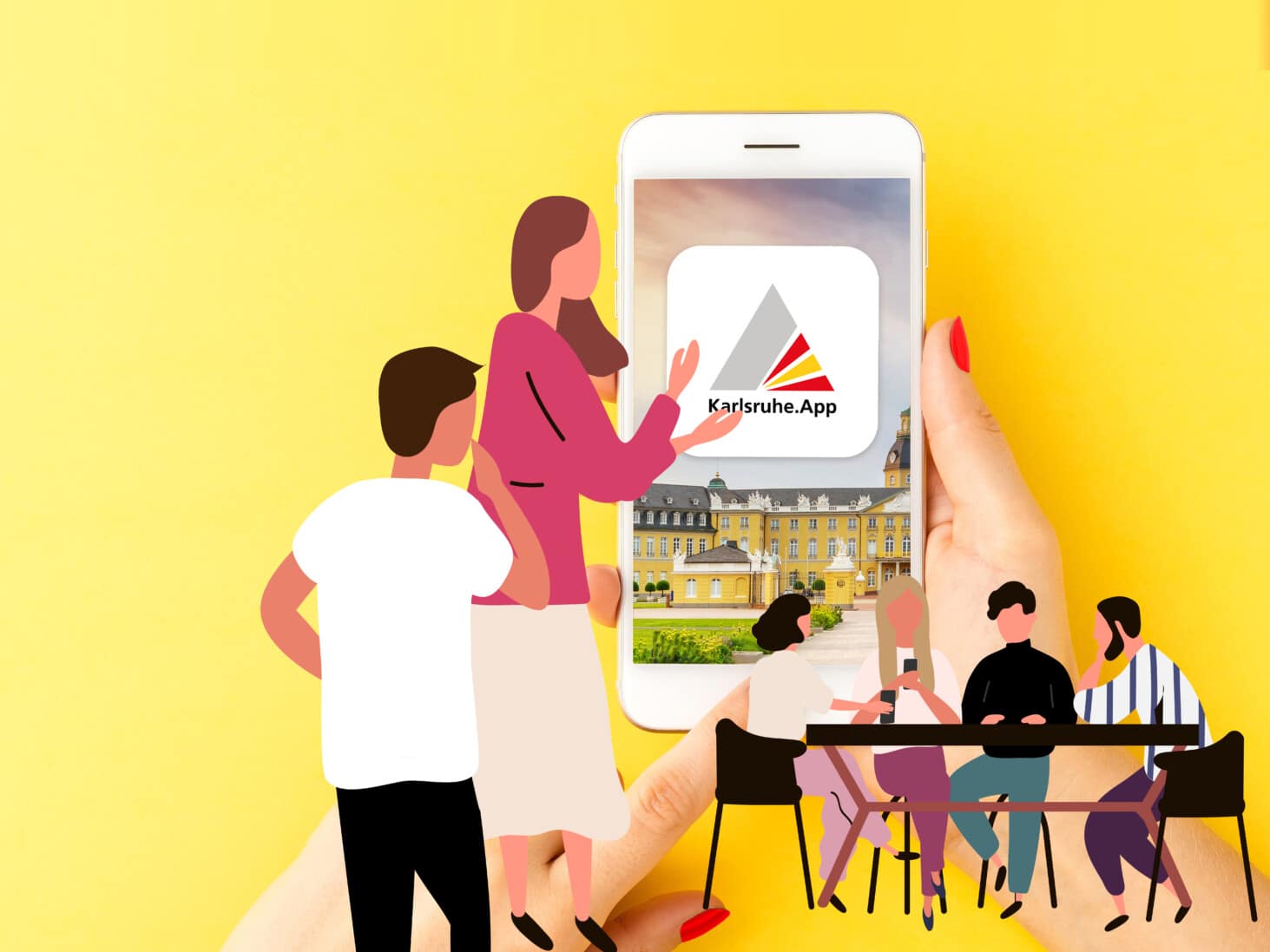
When a company launches an app, it’s nothing special. For a city, on the other hand, it breaks new ground in many areas. What does that mean? A lot of specific challenges – and very special opportunities for the Karlsruhe.app.
The Karlsruhe.app was launched at the end of 2021. A lot has happened since then. Information channels, a marketplace and a digital calendar of events offer citizens a constantly growing number of offers, services and functions that can be customized.
But what does it actually mean when a city makes an app? Most apps are developed by companies. There, a CEO can simply give their “Go!” – and off they go. A municipality, on the other hand, has to overcome a whole host of hurdles that companies don’t even know about: administrative, legal and – the sovereign here is not a CEO, but the citizens – also political.
Admittedly, many other cities have also launched apps in recent years. As a rule, these are services for a specific area – such as the city’s public transport services. However, the Karlsruhe.app is the first in Germany to bundle numerous city-wide digital services. It is not limited to municipal services: for the first time, a city app is also open to private-sector providers, clubs, associations and other bodies.
Another special feature: many municipal apps are actually operated by companies – such as municipal utilities, specially founded limited companies or even well-known telecommunications groups. Karlsruhe, on the other hand, operates the app itself. Only the technical development is in the hands of its technology partner CAS Software AG. There is a good reason for this decision, as the city also wants to use the Karlsruhe.app to provide access to “sovereign” services in future, such as passport and registration services. This involves sensitive citizen data – and this does not belong in the hands of third parties.
“Yes, and … What’s the problem?”, we laypeople ask ourselves – and shrug our shoulders. For a city, on the other hand, these things are uncharted territory in many respects.

Pioneering work with obstacles
For example, one of the project objectives was to provide a digital platform for clubs, associations, the local economy and IT start-ups. But on what basis can cooperation with non-municipal players be organized? How to regulate the fees? After all, a city must not work for profit.
The solution was to set up a “virtual public institution”. This was pioneering work for the administrative experts and lawyers involved. After all, there had never been anything like it in Germany before.
Decision-making also works very differently in a city than in a company. Certain changes – e.g. to provider contracts or free contract terms – cannot be approved just like that. They have to find a majority in the municipal council . And this council meets at fixed intervals and not according to need.
Another challenge is the financial scope of a municipality. Initially, the development of the Karlsruhe.app was funded by the state of Baden-Württemberg. However, since the go-live, it has had to make do with limited financial and human resources. In plain language, this means that a single position is responsible for all management, organization, communication, coordination and agreement tasks.
So there were many specific hurdles – including some that could not yet be overcome. For example, the single sign-on function was planned as an important added value of the Karlsruhe.app: A single registration should be enough to be able to use all city services within the app. This would be absolutely feasible from the app’s side. However, the state of Baden-Württemberg has not yet given its blessing. Because here too: safety first! When it comes to citizens’ data, single sign-on must wait until the technical issues have been clarified beyond doubt at state level.
Examples like these suggest that a municipal app project cannot be compared with a private sector project. But there are not only special challenges here – a city app also offers special opportunities. Keyword: participation, i.e. the involvement of users.
Karlsruhe.app users help shape the future
The people of Karlsruhe were already involved during the development phase. Back in 2018, at the start of the funding project, there was a citizens’ workshop to define the target groups for the final app. The content of the app was based on these target groups from the outset. In 2019, a citizen survey was then conducted to provide more detailed information about their wishes for a Karlsruhe.app. The result: mobility, citizen services and local networking played a particularly important role for the respondents – and were weighted accordingly during development.

In addition, citizens were able to try out the first prototype of the 2021 funding project as part of an accompanied usability test. This test provided valuable information on the structure and usage structure of the app.
When the app was launched at the end of 2021, it was deliberately designed as a “minimal viable product”. This means that a number of basic functions were already available. However, the main goal in this phase was to learn from user feedback as quickly as possible. After all, the app was not to be developed without people in mind.
To this end, a feedback function was placed prominently on the start page of the app. And this was (and is) actively used. In the first year alone, 16 new apps (“add-ins”), 21 new info channels and numerous new functions were added. Many of these were at the suggestion of users. Perhaps the most important innovation was the introduction of a completely new area: the digital events calendar (“Events”) went online in April. This was also a request from citizens.
However, democratic participation also takes place on a content-related level: in the city channels and add-ins, but also in the new district channels , Karlsruhe residents can find out about decision-making processes and municipal activities quickly, transparently and up to date. Numerous clubs and associations also find a platform here to present their positions. Naturally, the app is open to critical or controversial viewpoints. One example of this is , the channel of the Climate Alliance Karlsruhe.
Conclusion: there is still a lot to come
An app that is constantly evolving, users who play a key role in shaping this development … What does this mean for the near future? The design of the marketplace and the event area was recently revised. New channels are being added, e.g. “KA.nachhaltig” or “Kultur in Karlsruhe”. And the citizen services (eServices) have their own landing page. An interactive map with sports activities and a weather widget are already in the pipeline. The development momentum of the first year will continue seamlessly in 2023 with further innovations.
A city makes an app: it remains exciting to follow this unusual – and also courageous – digital story.
The Karlsruhe.app is a Smart City project by karlsruhe.digital.