
karlsruhe.digital Podcast - Episode 1: Minimal Carbon Internet.
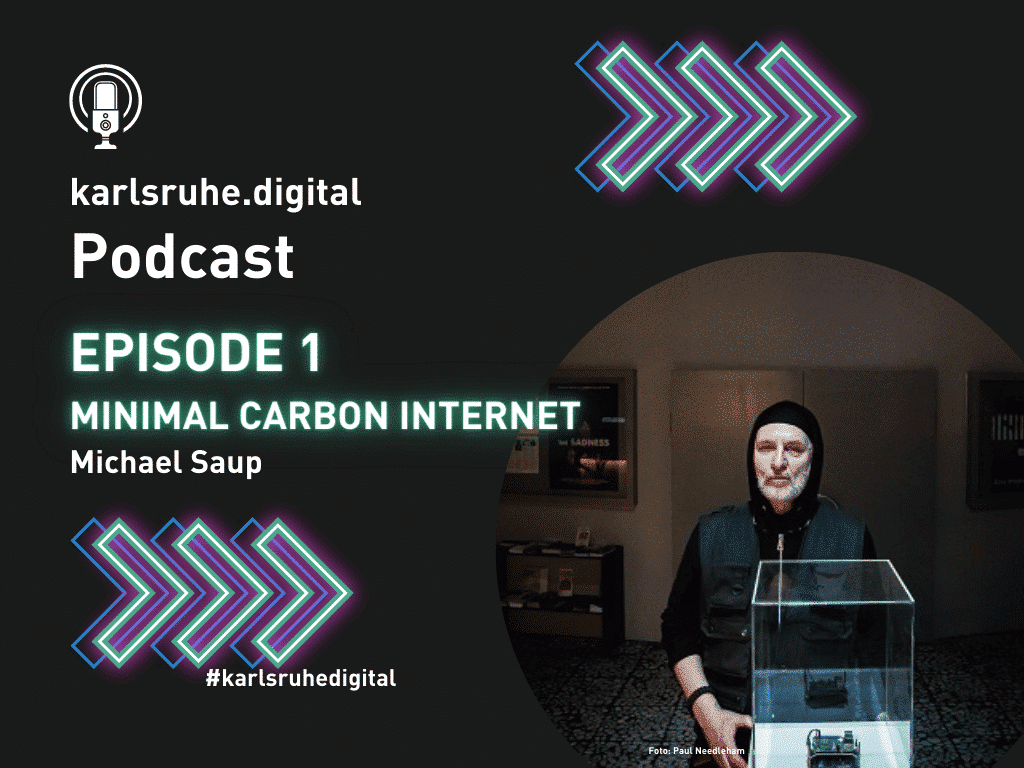
Minimal Carbon Internet – karlsruhe.digital draws attention to the energy consumption of data with an art project
The internet enables free access to knowledge, entertainment and global communication. However, the (re)world pays a price for this. The karlsruhe.digital initiative uses an art project to draw attention to energy consumption through digitalization and presents an energy-efficient website clone and a podcast on the topic.
The karlsruhe.digital initiative presents the “Minimal Carbon Internet” project, which was initiated by the karlsruhe.digital initiative’s culture working group. In cooperation with the ZKM |
Center for Art and Media Karlsruhe and the UNESCO City of Media Arts, the karlsruhe.digital minimal carbon site
aims to raise awareness of the connection between information and energy and to test approaches for concrete technical solutions in practice.
In addition to the well-known website of the karlsruhe.digital initiative, a clone with a 95% reduced energy requirement is now available. It was created by Michael Saup, visionary, artist, musician, filmmaker, professor and programmer. In the new karlsruhe.digital podcast, Michael Saup talks in detail about the project, the background and how it can continue.

Entertainment, art, information and communication have been shifting to digital since the mid-1990s. The coronavirus pandemic has driven this development even further. However, the increase in quantity and quality also increases energy requirements. If all the electricity for the internet were generated purely from lignite, the consumption would be equivalent to a lignite pyramid with a side length of 1,422 meters and a height of 905 meters. That is equivalent to the distance from the earth to the center of the sun.
“We know that the internet is our opportunity to promote human development, a valuable intellectual resource. We use this energy for a specific purpose,” explains Michael Saup, who has been researching the energy requirements of digital culture since 1999.
“The project is not about demonizing the internet . Rather, it’s about highlighting the challenges, creating awareness of the energy consumption of digitalization and showing possible solutions,” explains First Mayor Gabriele Luczak-Schwarz, Chairwoman of the karlsruhe.digital initiative.
“The artistic view of modern technologies in particular provides valuable impetus and opens up new perspectives for dealing responsibly with natural resources and shaping the future together more consciously ,” explains Martin Hubschneider, founder of the software company CAS Software AG, Managing Director of the high-tech network CyberForum and Chairman of the karlsruhe.digital initiative.
“The topic also fits perfectly into this year’s theme of KIT Science Week, where everything will revolve around the topic of sustainability and climate protection from October 10 to 15, 2023. Such perspectives are just right now,” also emphasizes Prof. Dr. Hirth Vice President of KIT for Transfer and International Affairs and Chairman of the karlsruhe.digital initiative.
In the eleven working groups of the karlsruhe.digital initiative, , each headed by a member of the steering committee, the digital aspects and success criteria of areas such as administration, science, education, culture and society, location factors for skilled workers, sovereignty, start-up culture, internationalization and innovation transfer are analysed and further developed. With this project, the culture working group is tapping into the great potential of using artistic interventions to approach the connection between energy consumption and digitalization.
“The work of the media artist refers to this connection between digital information processing and energy. It draws attention to the fact that our behavior online also has real consequences for our offline world. And it shows that there is another way!” adds Dominika Szope, Head of the Cultural Office.
Two websites, at first glance hardly distinguishable from each other and yet they are completely different: The artist Michael Saup has developed a version of the website karlsruhe.digital, which reduces its footprint by 95% – from 635 MB to 32 MB – with an almost identical appearance.
About Michael Saup
Michael Saup is a protagonist of digital and infossil art, instrumentalist, filmmaker, cosmographer, teacher and programmer. He began programming in 1980 while studying music. From 1989 onwards, he experimented with the possibility of computer-aided transformations of sound and image and took on a pioneering role in the development of software and interactive installations as an art form.