
#ABCdigitalKA - A for Everything digital in Karlsruhe?
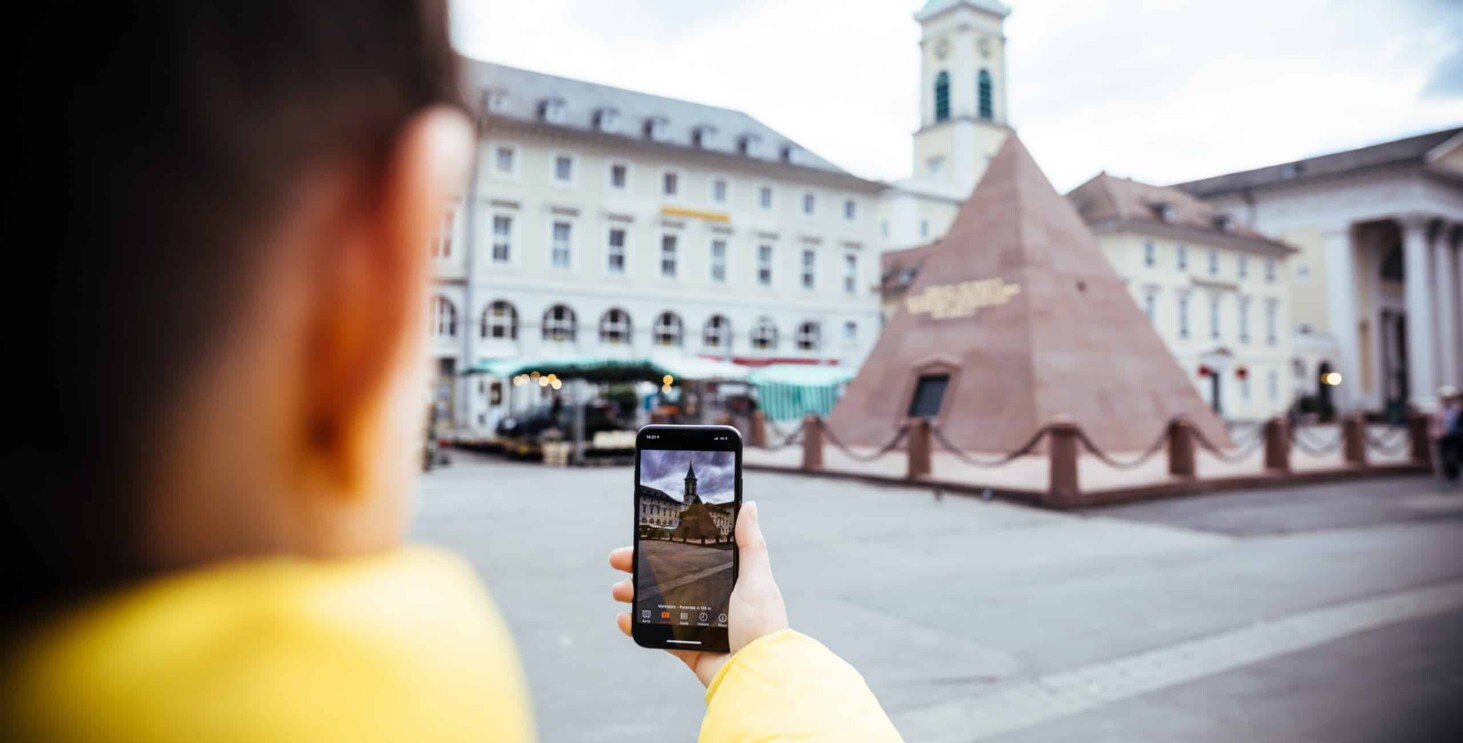
What actually makes Karlsruhe a digital stronghold and a driver of digitalization?
New year, new series: In our #ABCdigitalKA, each letter of the alphabet stands for a topic related to digitalization and digital innovations in and from Karlsruhe. Let’s start with “A for Everything digital in Karlsruhe?”.
To begin with, we want to take a closer look at what actually makes Karlsruhe a pioneer in terms of digitalization and digital innovation. Because just how digital is Karlsruhe?
1. Karlsruhe is a Digital Pioneer
Karlsruhe has a vibrant digital sector and with good reason. While many cities have only discovered digitalization in recent years, Karlsruhe was an early pioneer in this field: the term “computer science” was coined here back in 1957 and in 1972 the University of Karlsruhe (TH) founded the country’s first faculty of computer science, where Germany’s first e-mail was received twelve years later.
Since then, companies of all sizes – whether mobility start-ups, medium-sized cyber security providers or
listed communications groups – have found an ideal environment here. With over 4,800
companies and more than 30,000 employees, the digital sector is one of the
strongest economic factors in the region and generates over 45% of the city of Karlsruhe’s
trade tax revenue.
The
region has also recently made a name for itself internationally in the most important future topic of artificial intelligence (AI) – as one
of the few places where not only basic research and development in the
AI sector is taking place, but where the new technologies are also being used practically in everyday life
.
The outstanding excellence in education and research lays the foundation for groundbreaking innovations that radiate far beyond the city limits. The innovative strength of the fan-shaped city is the product of an outstanding university and research landscape. The region is home to over 25 leading universities and non-university research institutions.
The decisive role of IT and digitalization is becoming apparent time and again. In 2020, KIT became the Center for National High Performance Computing. In 2021, HoreKA, one of the 15 fastest supercomputers in Europe, was put into operation in Karlsruhe.
Whether in the areas of mobility, administration, infrastructure or energy – Karlsruhe is at the forefront everywhere as a digital, networked city. In 2020, Karlsruhe took first place in Germany in the “Digital Administration” category of the Bitkom Smart City Index and proved to be the city with Europe’s smartest cultural tourism in the “Cultural Heritage and Creativity” category of the “Capital of Smart Tourism 2020” competition. In addition, the fan-shaped city was the only city in Germany to be named a Pioneer City of the G20 Global Smart Cities Alliance as a municipal flagship project by the World Economic Forum.
A booming IT location like Karlsruhe naturally also needs a flourishing cultural and creative industry. After all, it is culture and creativity that shape future topics such as digitalization and enable innovation. In 2019, Karlsruhe was the first and only German city to be named a “UNESCO City of Media Arts“, joining the ranks of cultural capitals such as New York, Venice and Paris. One of the most impressive projects that the ZKM has produced in the field of media art is the Karlsruhe Schlosslichtspiele, which has been taking place since 2015. Every year, hundreds of thousands of visitors from all over the world marvel at the impressive projections on the façade of the palace, which marks the center of the radial layout of the fan-shaped city.

2. Karlsruhe is a team player
Future topics such as IT, energy and mobility dominate Karlsruhe’s economic and scientific landscape. However, the region owes its position as one of the world’s leading innovation locations not only to its strong digital sector and excellent research institutions, but also to a structural feature: the “Karlsruhe principle of short distances”. Business, science, administration and culture have committed themselves to the overarching goal of pooling their interests in the field of digitalization and further positioning the region as a driver of digitalization. To this end, the institutions work hand in hand – and each area contributes its expertise to a wide variety of projects. As a result, new ideas and innovative concepts can be implemented quickly, which would not be possible without this close integration.
In order to achieve more together and actively shape digitization, a strong umbrella brand is needed in addition to a shared conviction. In Karlsruhe, the course for the future was therefore set early on with the karlsruhe.digital initiative. The initiative brings together stakeholders from science, business, culture and administration. It pools the knowledge of 150 experts from over 50 institutions in order to exploit the opportunities associated with digital change, master challenges as a team and actively shape the future of the region.

A strong digital location needs strong networks. With over 1,200 members , CyberForum e.V. is now the largest regionally active high-tech entrepreneur network in Europe. Whether start-up, medium-sized software company, globally active IT group or research institution – the CyberForum brings together all players in the Karlsruhe region. The K³ Kultur- und Kreativwirtschaftsbüro and the MEKA Medienregion Karlsruhe e.V. take on these tasks for the creative industries, companies from the energy sector can be found in the EnergieForum and fokus.energie e.V., the Automotive Engineering Network serves as a regional platform for mobility and engineering. Across all sectors, the Gründerallianz Karlsruhe supports start-ups on their way to market entry.
Several attractive creative spaces have also been created in Karlsruhe in recent years , giving start-ups and companies the opportunity to bundle their existing potential and make effective use of synergies. These include the Alte Schlachthof with the Perfekt Futur start-up center and the consolidation and expansion center FUX, the Hoepfner Burg with the CyberLab, the Karlsruhe Technology Park and the Raumfabrik in Durlach.
3 Karlsruhe is an innovation hub
Supported by the strong digital sector, the proximity to research and development and the innovation-friendly climate of the entire region, a flourishing start-up scene has developed in Karlsruhe . Including the accelerators, there are twelve start-up centers in Karlsruhe with a total area of around 33,000 square meters, in which over 250 companies are located. Another start-up and growth center, the Smart Production Park, opened last autumn on the Hoepfner Brewery site with the CyberLab. The 5,400 square meter start-up space offers start-ups related to IT, AI, IT security and smart production access to 150 mentors and 1,200 companies.
Artificial intelligence (AI) is one of the topics of the future that has the potential to change our world for good. Karlsruhe recognized this early on and pooled the expertise of local institutions that had developed over decades. The fan-shaped city was recognized as a Digital Hub for Applied Artificial Intelligence by the Federal Ministry for Economic Affairs and Energy (BMWi) back in 2017. Today, the region is considered one of the most important locations in Germany for the development and application of AI.
There are excellent universities and renowned research institutions within a radius of a few hundred meters in Karlsruhe. Embedded in strong networks, established companies meet ambitious founders. The resulting innovative strength has given rise to several important centers of excellence in the Karlsruhe region. In addition to the Competence Center for Applied Security Technology (KASTEL) and the regional competence center “Artificial Intelligence for Work and Learning in the Karlsruhe Region” (KARL), Karlsruhe is home to several competence centers for SMEs 4.0 as well as the Karlsruhe Research Factory for AI-integrated Production by KIT and Fraunhofer.

4 Karlsruhe is shaping the future
Digital early education is a top priority in the fan-shaped city. In order to enable future generations to shape our (digital) future in the best possible way, the Karlsruhe Technology Initiative has been inspiring young people to study mathematics, information technology, natural sciences and technology (STEM) since 2014, in addition to providing sufficient daycare places and a wide range of educational opportunities across all school types. It is therefore hardly surprising that three of the 41 schools across Germany that won awards in the Bitkom Smart School competition are from Karlsruhe. However, the claim to be a STEM region is also clearly evident in the extracurricular area: CoderDojo Karlsruhe, Girls’ Digital Camps, SheCodes – numerous STEM support initiatives have an impact in and beyond the region.
In order to make topics such as artificial intelligence and robotics more tangible for people who have little contact with digitalization in their everyday lives, there are numerous formats in Karlsruhe that allow society to take a look behind the scenes – and to shape the digital transformation together with them.
The offer ranges from city-wide events such as the Colourful Night of Digitalization or the InnovationFestival @karlsruhe.digital to exchange formats on digital society and network culture such as the Karlsruhe digiTALKs, the gamification congress bizplay and the German-French AI conference AixIA. Karlsruhe is also home to LEARNTEC , Europe’s largest trade fair for digital education in schools, universities and the workplace. Anyone who wants to discuss the digital age in a relaxed atmosphere or simply make new contacts can do so at numerous after-work events – such as the regular netzstrategen Feierabend #nmfka.

5 Karlsruhe is more than just a workspace
As one of Europe’s leading IT locations , Karlsruhe offers everything that today’s (and tomorrow’s) specialists could wish for . Whether start-up, medium-sized company, large corporation, university, non-university research institution or administration – the multifaceted digital sector in the Karlsruhe region offers students and specialists career and further training opportunities in a wide variety of areas. And self-employed people are also always part of the action in the fan-shaped city with its numerous coworking spaces and creative spaces.
Four initiatives and centers, each with different areas of expertise, have joined forces in the IT security region of Karlsruhe: the Competence Center for Applied Security Technologies (KASTEL), the Competence Center for IT Security (KIS), the DIZ | Digital Innovation Center and the Karlsruhe IT Security Initiative (KA-IT-Si). Subdivided into the areas of research, research transfer, awareness-raising and networking, the association deals with the emergence of and protection against digital threats.
The topic of digital sovereignty is closely linked to IT security. In 2018, leading scientists from the field of IT security published the highly regarded “Karlsruhe Theses on European Digital Sovereignty” and the fair.digital seal of approval was also initiated in Karlsruhe, which stands for the fair treatment of users and the promotion of digital sovereignty for people and companies.

The real lifeline of digitalization and at the same time one of the most important advantages of the location is broadband expansion. In Karlsruhe, 98% of households already have an internet connection with 100 Mbit/s or more. At the same time, the region is rapidly driving forward the nationwide fiber optic expansion. In July 2021, over 11,000 more households in Karlsruhe received an FTTH connection. In the business parks Alter Schlachthof, Killisfeld and Raumfabrik, 33 kilometers of fiber optics will soon be laid, guaranteeing high bandwidths for 750 companies. Future topics such as cloud computing, AI applications and autonomous driving not only require fast internet, but also high computing power. In the Karlsruhe region, companies have access to several of the most modern, most powerful and, above all, most secure data centers in Germany.
The digital transformation can only succeed if it is approached holistically. To achieve this, it is important that society does not see digitalization as an opportunity to improve everyone’s lives. Karlsruhe is pursuing precisely this approach – and making digitalization tangible for citizens. EVA shuttles, the real-world laboratory for sustainable climate protection (KARLA), the real-world laboratory “Robotic Artificial Intelligence” at KIT the Artificial, KA-Feedback and Karlsruhe.app – digitalization is alive and well in Karlsruhe.