
#DigitalMindsKA - the people behind karlsruhe.digital: Professor Dr. Thomas Hirth

The initiative karlsruhe.digital arose with the collaboration of nine expert groups, over 25 institutions, and over 50 ICT companies. Together they pursue the vision for Karlsruhe to become a motor of digitalization – for competitiveness, quality of life and sovereignty and hence be a pioneer with regard to digital topics. a driver of digitalization It pools expert knowledge, promotes networking and deals with topics holistically in order to actively shape the digital future of the city.
And there are people behind it. People who are committed, who are passionate about something and who use their time, their ideas and their expertise for precisely this reason. We want to make visible who these people, the digital minds, are. Once a month, we ask the Digital Minds what drives them and what visions they have.
In the third part of our series, we visit Professor Dr. Thomas Hirth, Vice President for Transfer and International Affairs at the Karlsruhe Institute of Technology (KIT) and one of the chairmen of the karlsruhe.digital initiative, at his workplace in the KIT Presidential Building.
Students hurrying to lectures , a lecturer locking up her bike – and in between a squirrel that has just grabbed a nut and is climbing up a tree : KIT’s South Campus is a hive of activity as we walk to the centrally located Adolf Würth building near Karlsruhe city center. Here, in the former chemical engineering building from 1881, is the office of today’s interviewee Thomas Hirth.
We go to the second floor of the historic brick building and enjoy the view over the KIT grounds for a moment . At this moment, Thomas Hirth comes around the corner, greets us in a friendly manner and takes us straight into his office. He hangs his jacket over the back of his chair, takes a quick look at his e-mail inbox and then sits down at the conference table with us. Now take a deep breath and have a sip of coffee.
Taking a bird’s eye view of the Campus South site from , we would like to start by asking Professor Hirth what he thinks of first when he hears the word Karlsruhe. “Well, the is simple: when I hear Karlsruhe, I first think of an excellent science city, with a high level of dynamism and incredible cohesion. At least that’s what I perceive.” He puts down his coffee cup and smiles: “And you know, it wasn’t always like this. When I studied in Karlsruhe in the early 1980s, back then at the University of Karlsruhe (TH), everything here at Karlsruhe was – to put it casually – a bit ‘dusty’.”
Karlsruhe one of Europe’s most attractive digital locations for Hirth
After studying chemistry at , Hirth spent many years at the Fraunhofer-Gesellschaft, where the now 60-year-old most recently worked as head of a Fraunhofer Institute and Professor at the University of Stuttgart. When he finally returned to KIT on January 1, 2016 after eight years at in Stuttgart, the change that had taken place in the city was clearly visible and tangible for him. Hirth looks at us and grins: “And I’m not talking about all the building sites in Karlsruhe, which, by the way, shouldn’t be seen in a negative light either. Because when everything is finished , the city will be even more liveable”. Rather, he is thinking of Karlsruhe’s transformation into one of Europe’s most attractive digital locations with a flourishing start-up scene, he adds while he suddenly discovers the karlsruhe.digital sticker on the back of our laptop .
“As someone who has been active outside Karlsruhe for many years, I think that the change within the city has a lot to do with the self-image of the various players and actors. This is because digitalization is a cross-cutting issue that affects all areas of life . For this reason, the cooperation of business, science, administration and culture is indispensable for the major social challenges that we will face in the coming decades . But that only works if you know and trust each other,” emphasizes Hirth. “This is exactly the case in Karlsruhe – and initiatives such as karlsruhe.digital, which unite all players under one roof, play a key role in this . If, for example, a new project format is advertised , we can exchange information within our network at short notice and react quickly . That makes us strong.”
Digitalization only works with people
However, that alone is not enough . During our conversation, Hirth repeatedly refers to a topic that is very close to his heart: “The digital transformation can only succeed if we manage to take society with us.” As part of his first term of office as Vice President at KIT until the end of 2021, Hirth dedicated himself to the topics of innovation and international affairs. In this role, his focus was primarily on cooperation with the business community. With his second term of office, which he took up this year, he has assumed the role of Vice President for Transfer and International Affairs, thereby expanding his remit. The aim of his second vice presidency is therefore to address interaction with society even more strongly. “We have to make digitalization visible to citizens, explain to them why we are doing what we are doing – and how it benefits us as a society.”
Formats such as the KIT Science Week and the colourful Night of Digitalization show what this can look like in practice at . The former combines a high-level scientific conference by and with internationally renowned scientists with diverse events for the public and thus transports the major scientific topics into society. The Colourful Night of Digitalization, on the other hand, brings digitalization to life for citizens with hotspots and events throughout the city. “Here we find out what moves people, where they see opportunities, but also what they are afraid of. Because we can only shape digitalization together if we know what drives people ,” says Hirth.
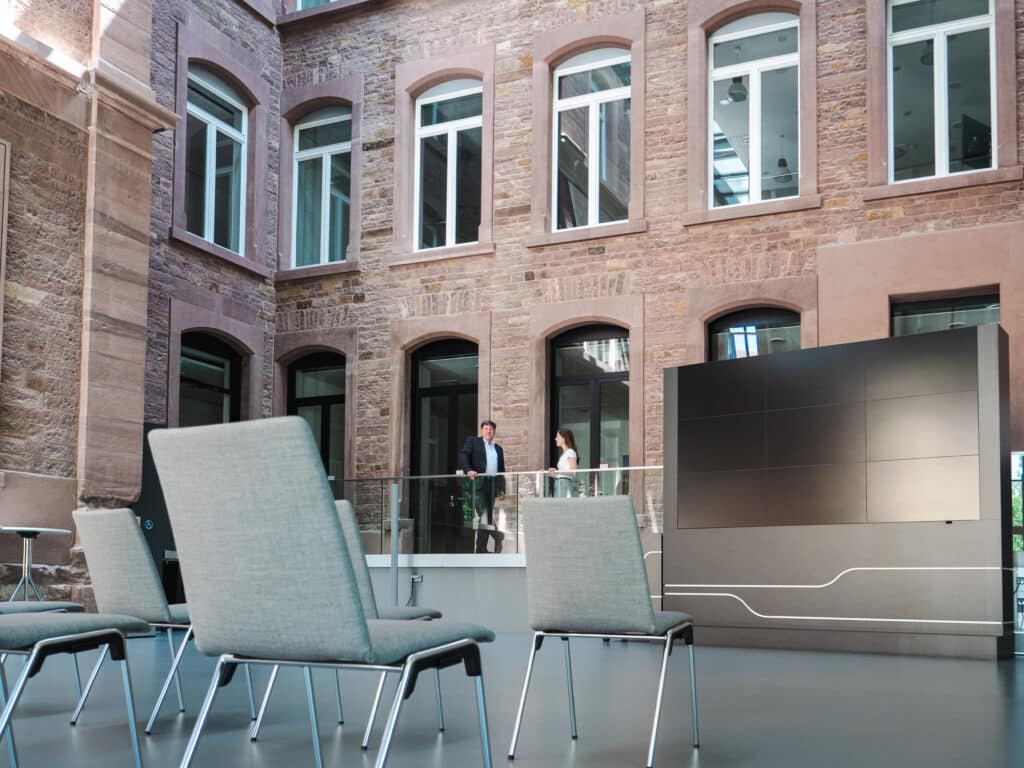
All of a sudden it gets brighter in the room. The gray clouds in the sky have disappeared and the afternoon sun shines through the large windows of Hirth’s office. We’ve been waiting for this! Time for photos. Hirth takes us to the spacious roof terrace, which the KIT uses for receptions and other events. Today it is empty and the impressive view is all ours.
It’s all in the mix: It’s important to maintain a balance in both professional and private life
While we take pictures, we talk to Hirth about his day-to-day work. He pauses briefly , lets his gaze wander over the city and then tells us that there is no such thing as a “normal” working day for him. “No two days are the same In my role as Vice President for Transfer and International Affairs, I deal with many different topics and therefore have to attend a wide variety of appointments. I had a meeting with a foundation earlier, and tomorrow I’ll be in Paris at a big start-up trade fair.” We listen intently to his words and only notice in passing how Hirth takes us on a brief tour of the campus. He leads us through the foyer of the Tulla lecture hall, which is currently being set up for an evening event. At the place where the symbiosis of historic building, contemporary architecture and state-of-the-art media technology is particularly evident, he continues to report on his everyday life. “The only things that are the same every week are the Executive Committee meetings every Monday- and the Senate meetings once a month. Otherwise, meetings and events at KIT alternate with those at other research institutions, associations, companies, foundations, politics and administration. There’s always something to do – and I really appreciate that. That’s what makes the job interesting . And you can certainly imagine how much is currently happening in areas such as mobility, energy, information and sustainability.”
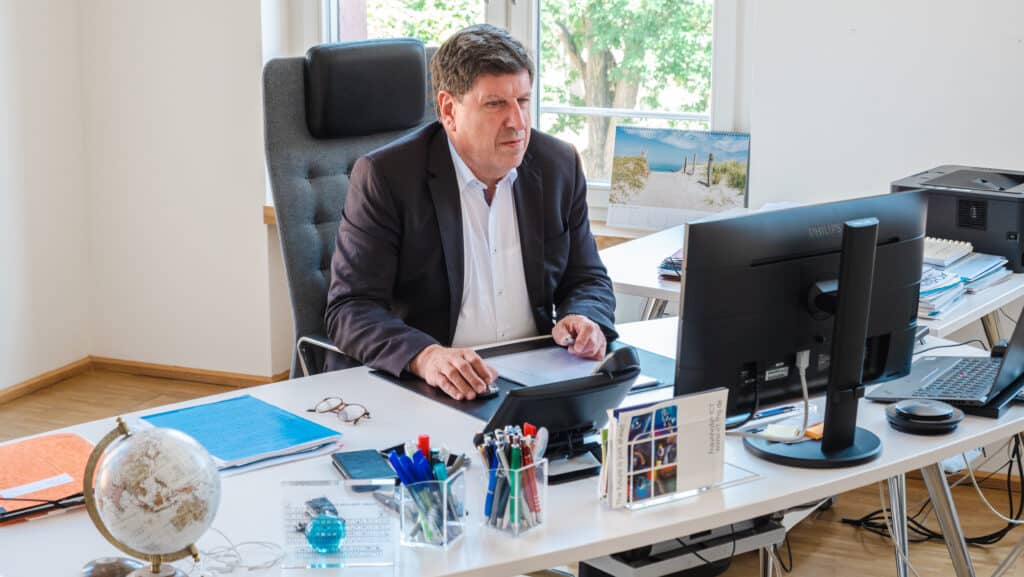
Our appointment is almost over with the short tour. We accompany Thomas Hirth to his office to collect our things. As we do so, the PhD chemist sits down at his desk and points to a globe that stands directly in front of him next to a miniature glass version of the periodic table. “People tend to forget that many activities in the field of digitalization take place internationally. Exchange with other players and stakeholders is therefore immensely important, not only at a local but also at a global level . As a result, you not only learn to better assess your own strengths and weaknesses , but can also solve problems together more quickly and more efficiently. If we continue to take this to heart in the future, even a comparatively small city like Karlsruhe can become an international beacon of digitalization for mobility, production, administration and science.”
Before we leave, we take one last look at our notepad. It occurs to us, , that we have forgotten another question that we ask all digital minds: With all the daily commitments, how do you actually switch off? Hirth smiles: “It’s not always that easy. But when I find the time , I like to go to concerts and exhibitions, travel to France – and I like to work in the garden. This is my personal oasis and gives me the opportunity to switch off from everyday working life.”
With these words, Hirth shakes our hands and we say goodbye. His next appointment is already waiting outside his office. His last one for today, as he then has to pack for his trip to Paris the next day. Meanwhile, we stroll across the KIT South Campus back to the streetcar and ask ourselves whether a digital mind can ever completely switch off and leave everyday life behind.
Cover picture: Netzoptimisten