
Coding da Vinci: The hackathon for cultural data visits Karlsruhe
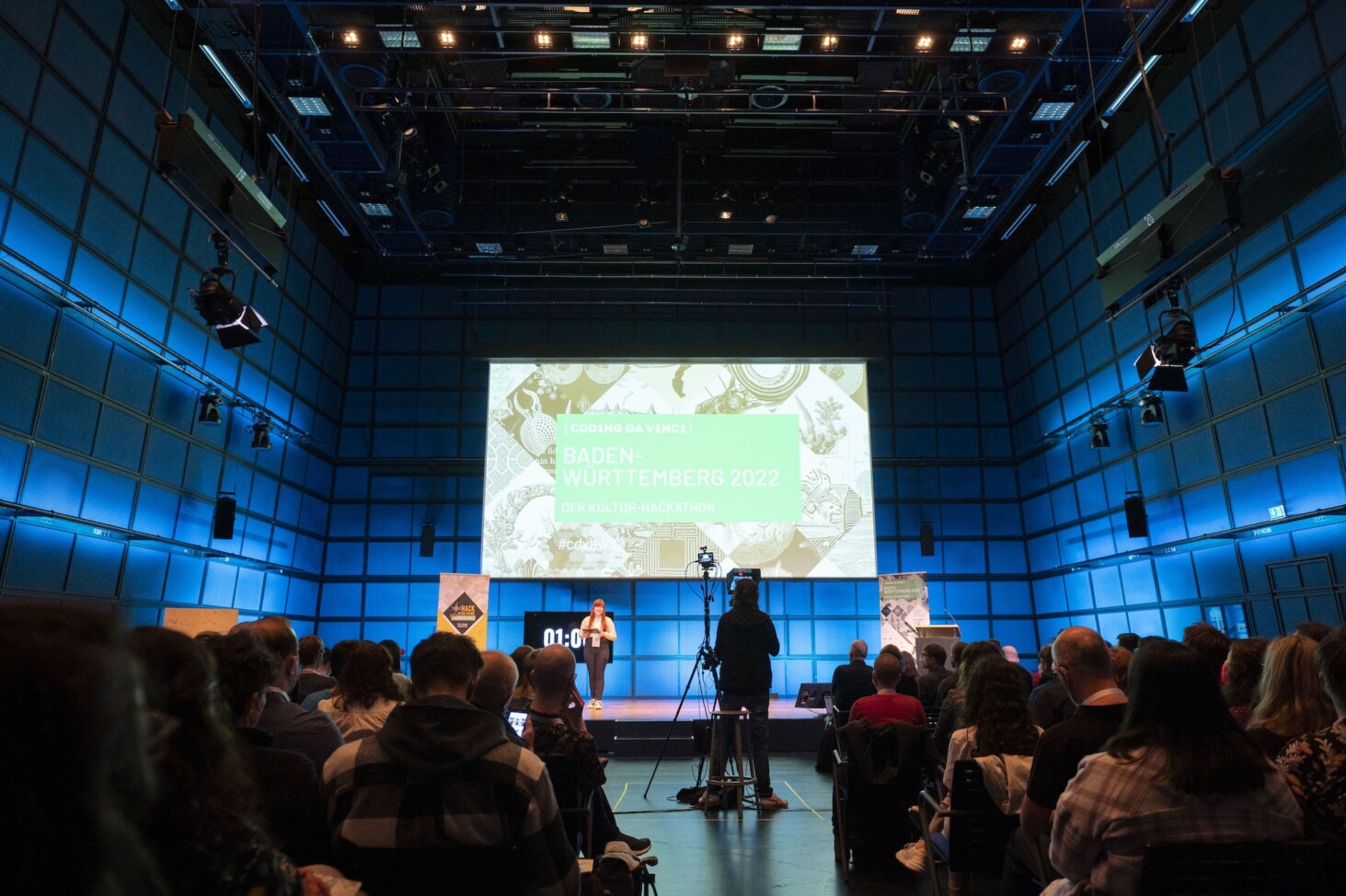
This year, the Coding da Vinci cultural hackathon took place in Baden-Württemberg – and impressively demonstrated what is possible when the worlds of culture and technology come together.
A child looks at herself fascinated in the mirror and marvels at the artfully designed dress that the “Magic Mirror” conjures up on her body. This is made technically possible by a combination of a camera, a touch display and artificial intelligence. But what is really special about it is something completely different: the texture of the garment is generated from 236 works of art from the Staatsgalerie Stuttgart and adapted to the viewer’s body.
The “Magic Mirror” was developed as part of the Coding da Vinci cultural hackathon, which took place in Baden-Württemberg this year. “What sets Coding da Vinci apart from other hackathons is that it is linked to our cultural heritage,” explains project coordinator Sylvia Petrovic-Majer from
Of course, the fact that some data is now available digitally does not mean that it is also freely available – and this is precisely where projects such as Coding da Vinci come in. “It’s about opening up all the artifacts and metadata to the public, because after all, most art and cultural institutions are funded by taxpayers’ money. That’s why art and culture must have a firm place in people’s everyday lives and not just be a luxury good,” emphasizes Petrovic-Majer.
A total of 34 museums, libraries, archives and memorials from the southwest did not take long to agree – and made their data openly available for Coding da Vinci. More than 180 coders, creatives, artists and students met at the ZKM | Center for Art and Media in Karlsruhe for the hackathon kick-off at the beginning of May.

Creating something new from old cultural data
One of them is sculptor Friedrich Riedelsberger: “I’ve been following Coding da Vinci for quite a while – and when I saw that the cultural hackathon was coming to Baden-Württemberg this year, I decided without further ado to take part in the kick-off at the ZKM and watch the presentation of the data sets.”
Like many others, the artist did not have a specific idea in mind beforehand. Instead, he found the idea of working on an interdisciplinary project with open cultural data and creating something new from it exciting.
“On site, data sets from the Esslingen district archive aroused my interest, which is how I got to know my team,” explains Riedelsberger. “While I contribute my knowledge of art history, Robert takes on the role of programmer, Liliya is a graphic designer and Pia is studying communication sciences. Together, we developed the idea for an app for the district of Esslingen.”
The resulting app KIS – “Kunst im Städtle” (Art in the Town) takes people on an interactive journey of discovery through the Swabian towns and villages based on the geodata provided, making it possible to experience art in public spaces – reflected through the voices and faces of prominent historical figures. You move freely through the landscape and discover monuments and sculptures in a playful way, but also learn more about their significance and history.
In total, more than 20 project teams used the open cultural data to implement their ideas during the seven-week sprint phase. The result was a wide variety of digital applications: Starting with the “Magic Mirror” mentioned at the beginning and the app by Friedrich Riedelberger, to a role-playing game that combines romantic painting with the retro look of early video games and specially created illustrations, to a card game that deals with the topics of humor and subjectivity, the winner of which then receives one of the playing cards as a non-fungible token (NFT).
Hackathons offer added value for society
“A cultural hackathon ensures that people see what is possible – and what can be created from the data. This in turn leads cultural institutions to think more about which data they can open up for such projects,” explains Sylvia Petrovic-Majer, who has been campaigning for open data in the cultural sector in Austria for many years. “At events like Coding da Vinci, it’s incredibly exciting to see what happens when so many people come together on a topic and share their knowledge. This innovative field of interdisciplinary knowledge gives rise to ideas and projects that a single person would not be able to implement.”
Ultimately, a cultural hackathon like Coding da Vinci, which has been bringing cultural institutions together with students and the open data and creative tech communities year after year since 2014, is all about creating new things together by sharing knowledge.
On the other hand, hackathons also help to rid the term “hacking” of its stigma. This is because the media still portrays hacking as something bad. When it is reported on, it is usually in a negative context, such as a hacker attack.
“Ultimately, hacking just means seeing and looking at things a little differently, thinking outside the box, so to speak. That’s why we’re opening a creative hacking space with Coding da Vinci, where we rethink things and create something new from the data sets while still protecting personal rights and copyrights,” explains Petrovic-Majer. “Examples like this simply need to be brought much more into the media in order to raise awareness of what hacking actually means and what innovations can be created as a result.”
An overview of all the projects created as part of Coding da Vinci can be found here.
Photos: Tanja Meißner, CC BY-SA 4.0