
she.codes - by women for women.
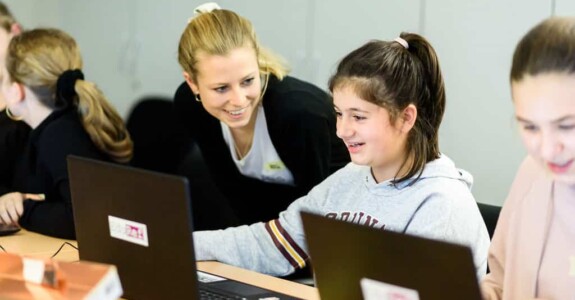
Promoting young computer scientists from Kalsruhe has an impact far beyond the city limits.
The university group she.codes@KITxTUM brings together STEM students from the Karlsruhe Institute of Technology (KIT) and the Technical University of Munich to get young girls interested in computer science and technical topics.
Digitalization is changing the world in which we live and work at an unprecedented pace. Studies show that 11 to 14-year-olds are growing up with smartphones and the internet. The coronavirus pandemic and the associated online lessons have also improved media literacy even further. However, there is a difference between consuming technology, for example through social media, and understanding the technical mechanisms behind it, and there are clear differences between the sexes.
A 2017 UNESCO study entitled “Cracking the code: girls’ and women’s education in science, technology, engineering and mathematics”, for example, found that girls lose interest in STEM subjects between the ages of 15 and 16 – even though there is hardly any difference between women and men up to the age of around 11. One of the main reasons for this is that teachers tend to encourage girls and boys differently.
This so-called gender tech gap is also reflected in the degree courses: there are still significantly more men than women in computer science. Only 29 percent of students at the Karlsruhe Institute of Technology are female – and the figure for female professors is just under 14 percent. The differences become even clearer when you look at the Department of Computer Science: last semester, only around 10% of the 2,254 students were female. And this has very real consequences. In an increasingly digitalized world, women not only have a significantly lower level of digitalization than men, as a
The university group she.codes@KITxTUM wants to change that. “In our workshops, we try to awaken the participants’ interest in programming in a playful way – and to give everyone the necessary development time through individual support. Ultimately, we want to be the anti-stereotypical role models that change the mindset of future generations.”
Girls need female role models in computer science
“Studies show that women underestimate themselves more often than men. In addition, male-dominated industries have a deterrent effect on many young girls. Gender stereotypes of male programmers are not role models for schoolgirls and offer no opportunity to identify with them,” explains Lena Stempfle, one of the founders of the university group she.codes@KITxTUM. “This is why the concept of “anti-stereotypical role models” is crucial. An anti-stereotypical role model is someone who contradicts a standardized mental image that is prevalent in society. In other words, we actually need to see contrasting examples to change our minds.” Founded in June 2019 by three female students at KIT, the university group now has 46 members who act as the role models needed to change the mindset of future generations.
“The desire to pass on practical programming skills and motivate through positive experiences led to the rapid implementation of the first face-to-face workshop in October 2019, which received great feedback. Since then, around 500 young people have taken part in our online and face-to-face courses. In addition, since the start of the pandemic in April 2020, we have been working completely remotely, in some cases across national borders, and have expanded to include a location at the Technical University of Munich.”

No prior knowledge is required for the free she.codes@KITxTUM courses
As a voluntary initiative, she.codes@KITxTUM offers the courses free of charge. This aspect is particularly important to the initiators, as it makes their workshops accessible to everyone and contributes to educational equality.
“Our courses aim to teach computer science skills to girls between the ages of 11 and 14 in a fun and sustainable way. We want to teach them the most important basics of the Python programming language and show them how easy it is to write their first computer programs,” explains Lena, who is a computer scientist herself. “With the code-to-getHER program, we want to build a longer-term bond with the girls over four months. Alongside the monthly online workshops, we offer 1:1 mentoring for the girls in order to strengthen the image of women in IT together. Between the sessions, there are voluntary task sheets, which are gladly accepted by the participants. At the successful conclusion of the workshop series, each girl receives a goodie bag containing a book for children and young people about IT, healthy sweets, stickers and a certificate.”
Of course, the participants, who are on average 12 years old, can also exchange ideas with the mentors at any time afterwards. In addition, she.codes@KITxTUM is working on continuously expanding its offering in order to offer follow-up workshops for every level of knowledge in the future. “We are particularly proud of the fact that our online workshops are not restricted to our two locations, but have also welcomed participants from other German-speaking countries, such as Switzerland and Austria, or even from a German school in South Africa.”
You are currently viewing a placeholder content from Default. To access the actual content, click the button below. Please note that doing so will share data with third-party providers.
More InformationEnthusiasm for STEM subjects must be awakened at school
The she.codes@KITxTUM initiative aims to inspire more young girls to study STEM subjects and professions, but would also like to see a rethink in school education in other areas: “Compulsory elective subjects in almost all types of school are chosen in Year 8. Here, pupils decide whether they want to specialize in technical, economic, social or artistic subjects, depending on what the school offers. If they choose a non-technical specialization here, the specialization for the next few years and often also for the subsequent course of study or training is pre-programmed,” explains Lena, who is currently working on setting up a school network herself. “That’s why an early enthusiasm for computer science and technical subjects (from around year 7) is important. However, we often see a lack of support for girls in technical subjects. Especially during puberty, parents and teachers unconsciously encourage boys rather than girls in STEM subjects.”
Studies show that 11 to 14-year-olds are growing up with smartphones and the internet. The coronavirus pandemic and the associated online lessons have further improved media literacy. However, there is a difference between consuming technology, for example through social media, and understanding the technical mechanisms behind it. “In our workshops, we try to arouse the participants’ interest in programming in a playful way – and to give everyone the necessary development time through individual support. Ultimately, we want to be the anti-stereotypical role models that change the mindset of future generations.”
Next dates:
Python Beginners Workshop – August 21, 2022
August 21, 11:00 am – 1:00 pm
Python beginners workshop
– September 04, 2022
September 4th , 11:00 am – 1:00 pm
code-togetHER program
2022-2
September 25 , 11:00 am – 11. December , 1:30
pm
If you would like to support she.codes@KITxTUM, you can do so at codes.education to get in touch with the university group at any time.