
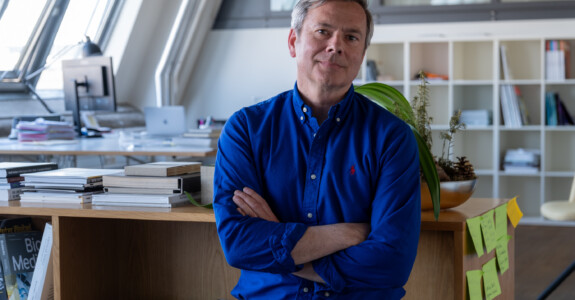
DigitalMindsKA: Holger Neinhaus, Executive Director of the ZKM | Center for Art and Media, Karlsruhe
The Initiative karlsruhe.digital brings together stakeholders from Karlsruhe’s academic, business, cultural, and administrative sectors with the goal of advance Karlsruhe as a driving force behind digitalization: for competitiveness, quality of life, and autonomy. It brings together expert knowledge, promotes networking, and addresses issues holistically to actively shape the city’s digital future.
And behind all of this are people. People who are passionate about, for example,passion, and that’s exactly why they contribute their time, ideas, and expertise. We want to shine a light on who these people—the Digital Minds—are. Once a month, we ask the Digital Minds what drives them and what their visions are.
In the fourteenth installment of our series, we visit Holger Neinhaus, Executive Director of the ZKM | Center for Art and Media in Karlsruhe.
An Office with a Vision
Lorenzstraße in Karlsruhe. Before us stretches the long, striking facade of one of the world’s most important media art centers. We have an appointment here with Holger Neinhaus, the executive director of the ZKM | Center for Art and Media Karlsruhe.
We head to the reception area, and while the staff member checks us in, we catch a quick glimpse of the current exhibition. Then we take the elevator up to the upper floor, where Neinhaus is already waiting for us in his bright, loft-style office. Fancy another cup of coffee before we get started? We certainly don’t say no, and in the meantime, we admire the view of the adjacent buildings through the large windows.
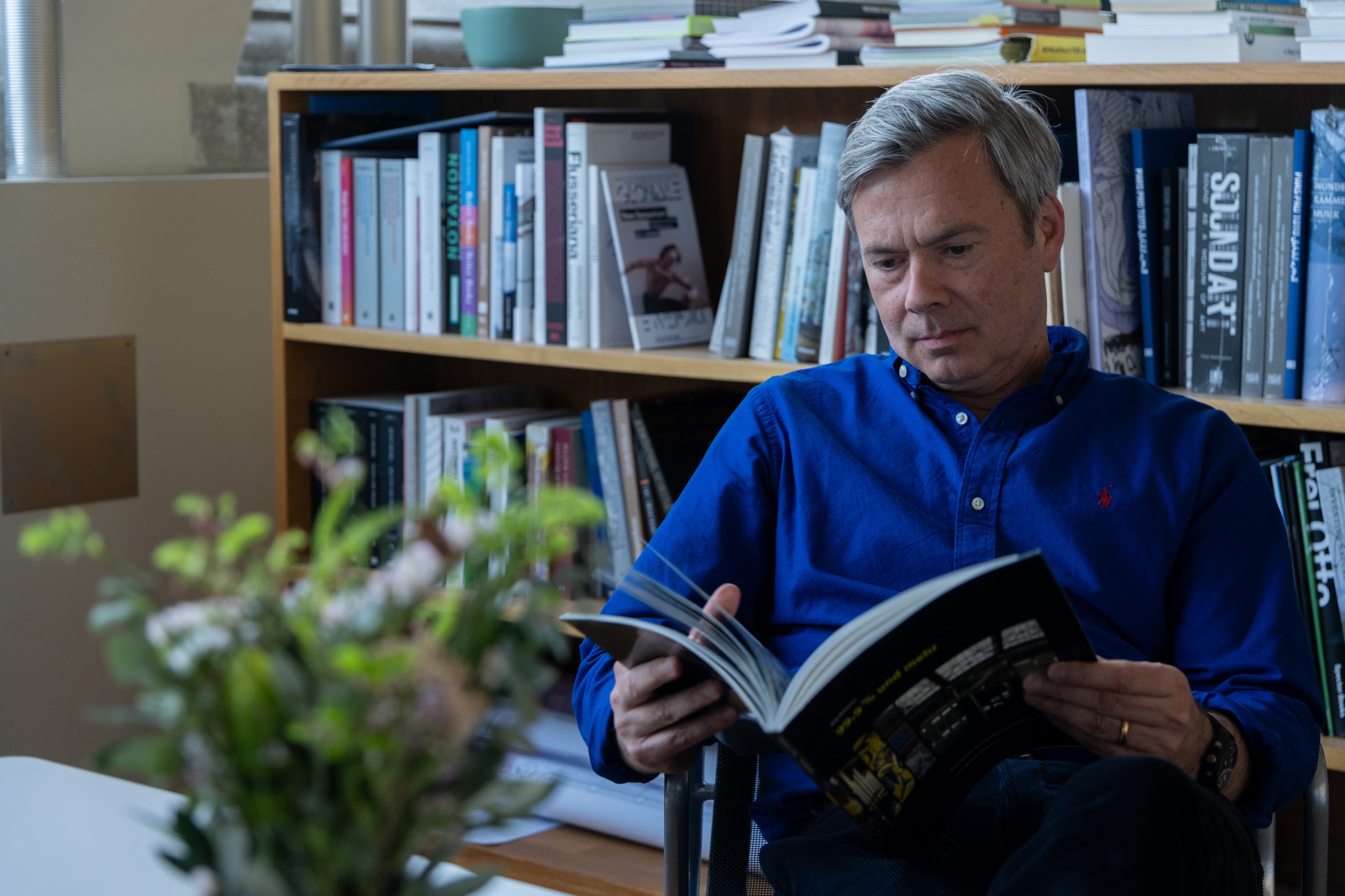
We take a sip and get right to the first question. What’s the first thing that comes to Neinhaus’s mind when he hears “Karlsruhe”? He thinks for a moment and then begins: “Before I came to Karlsruhe, the first thing that would have come to mind would have been the Federal Constitutional Court,” he says. “Then, of course, the ZKM and media art—simply because I’m interested in art.” He pauses briefly: “And today, I’d definitely add KIT to that list. I only realized its significance once I got here. I simply hadn’t grasped the leading national and international position of this research institution before.” He leans back: “But I’ve also come to appreciate the art scene as a whole. These days, I wouldn’t limit myself to just media art.”
From Consulting to a Cultural Institute
The story of how Holger Neinhaus ended up in this office is not one you hear every day. “I’m something of an oddity in the cultural sector.” That’s because his academic path first took him to Würzburg, where he studied business administration, and then to Columbia Business School in New York. What followed was a career in consulting spanning more than two decades, most recently as a partner and co-owner of a strategy consulting firm.
Then, at some point, came a moment of pause. “I took some time to reflect on what I really want to do,” he says. In Düsseldorf, where he lives, he volunteered in the arts: on advisory boards, curatorial committees, and in cultural organizations. “And time and again, I was told that the cultural sector could be a serious option for me.” He says this without any drama, more with the matter-of-fact composure of a man accustomed to analyzing situations. A headhunter helped him take the decisive step. “She offered me an interim position at the ZKM.” Holger Neinhaus smiles. “That was ideal for me. I could get a feel for whether the industry was exciting for me, whether I’d enjoy it, and whether I’d be a good fit.” The planned six months flew by. Both sides realized: It’s working. In the end, Holger Neinhaus signed a five-year contract. His family stayed in Düsseldorf. He rented an apartment in Karlsruhe and commutes home on the weekends. “The train works well. It’s a two-and-a-half-hour ride.”
Art as a Bridge Between Technology and Society
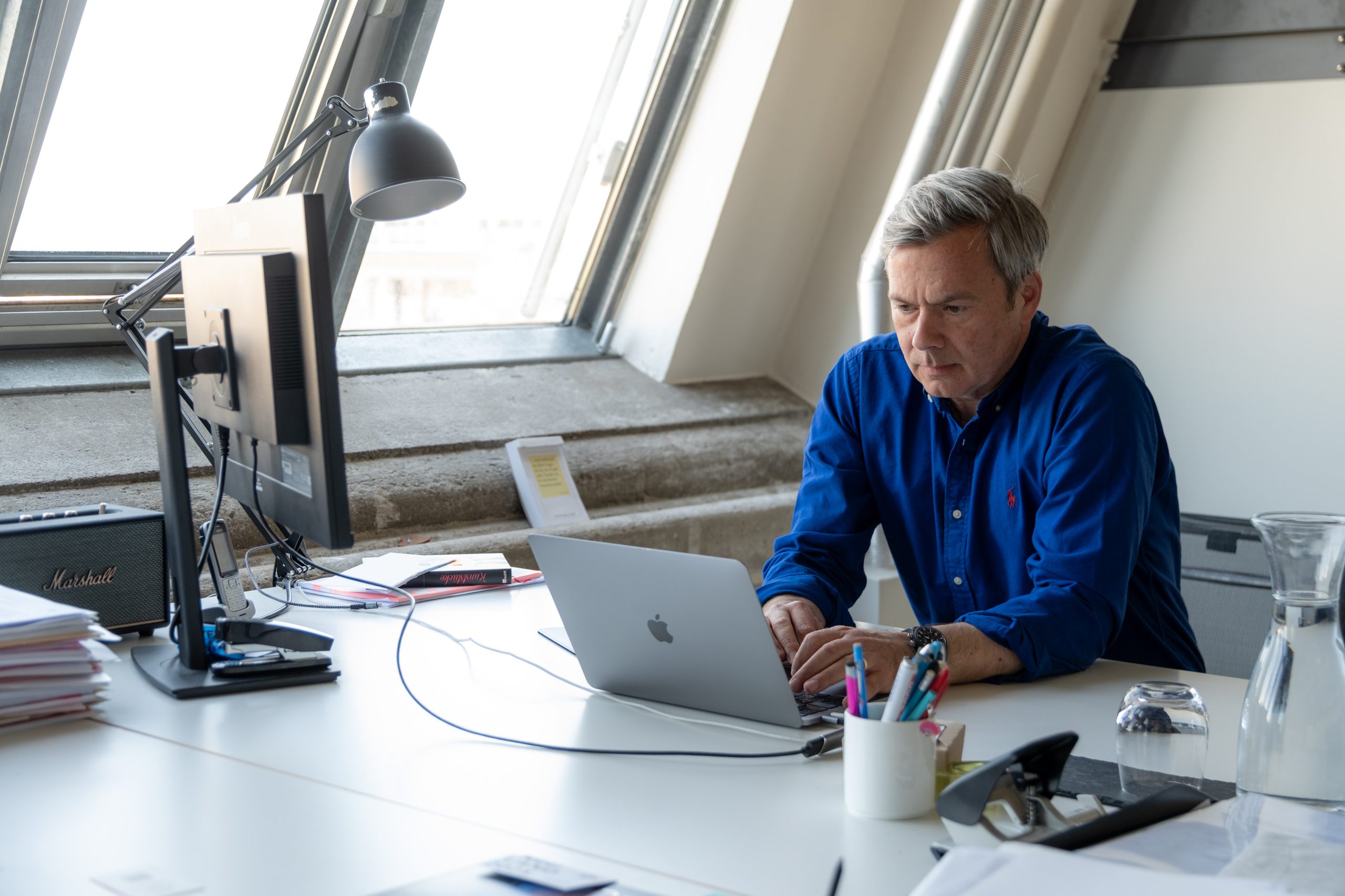
We take a look at our notes. One point in particular catches our attention: Neinhaus is the representative for the cultural sector at karlsruhe.digital. How do culture and digitization fit together? He doesn’t need any time to get started. “The ZKM views art as something that operates at the intersection of technology and society,” he says. “It’s about building a bridge—between what technology does and what that means for society.” Assessing this connection, making it transparent, and making it accessible to a broad audience—that, he says, is the institution’s core mission. He glances briefly out the window before continuing. “When the internet first emerged, everyone said it was the big leap that would change everything. Looking back, though, it all took much longer.” It’s an observation, not a criticism. Holger Neinhaus is no technology skeptic. On the contrary. But he thinks in terms of time, not headlines.
A City Full of Initiatives
Then he brings up Karlsruhe. “I’m still surprised by all there is to see in Karlsruhe,” he admits. “The number of initiatives is much higher than in Düsseldorf, for example. Even in the arts. That’s unusual.” This applies to business just as much as it does to culture. “It’s amazing how much commitment there is within the city—from private citizens, the business community, the arts and culture, and academia.” He mentions the Cyberforum, karlsruhe.digital, and the close connections between the various stakeholders. “You keep running into the same people—the same entrepreneurs. I think that’s great. And unique.” Elsewhere, he says, this kind of thing comes from the Chamber of Commerce and Industry or the economic development agency. “Here, it’s much more deeply rooted. There’s a strong sense of unity in driving the region forward. And the ZKM is right in the middle of it all.”
Experience Instead of Explain
At this point, Holger Neinhaus suggests we continue our conversation as he guides us through the building. We follow him into the exhibition spaces, through the tall, light-filled halls, past installations that invite us to look, participate, and reflect. Visitors stop, try things out, and move on. It is precisely this encounter between technology and the audience—which Neinhaus was just talking about—that becomes visible here.
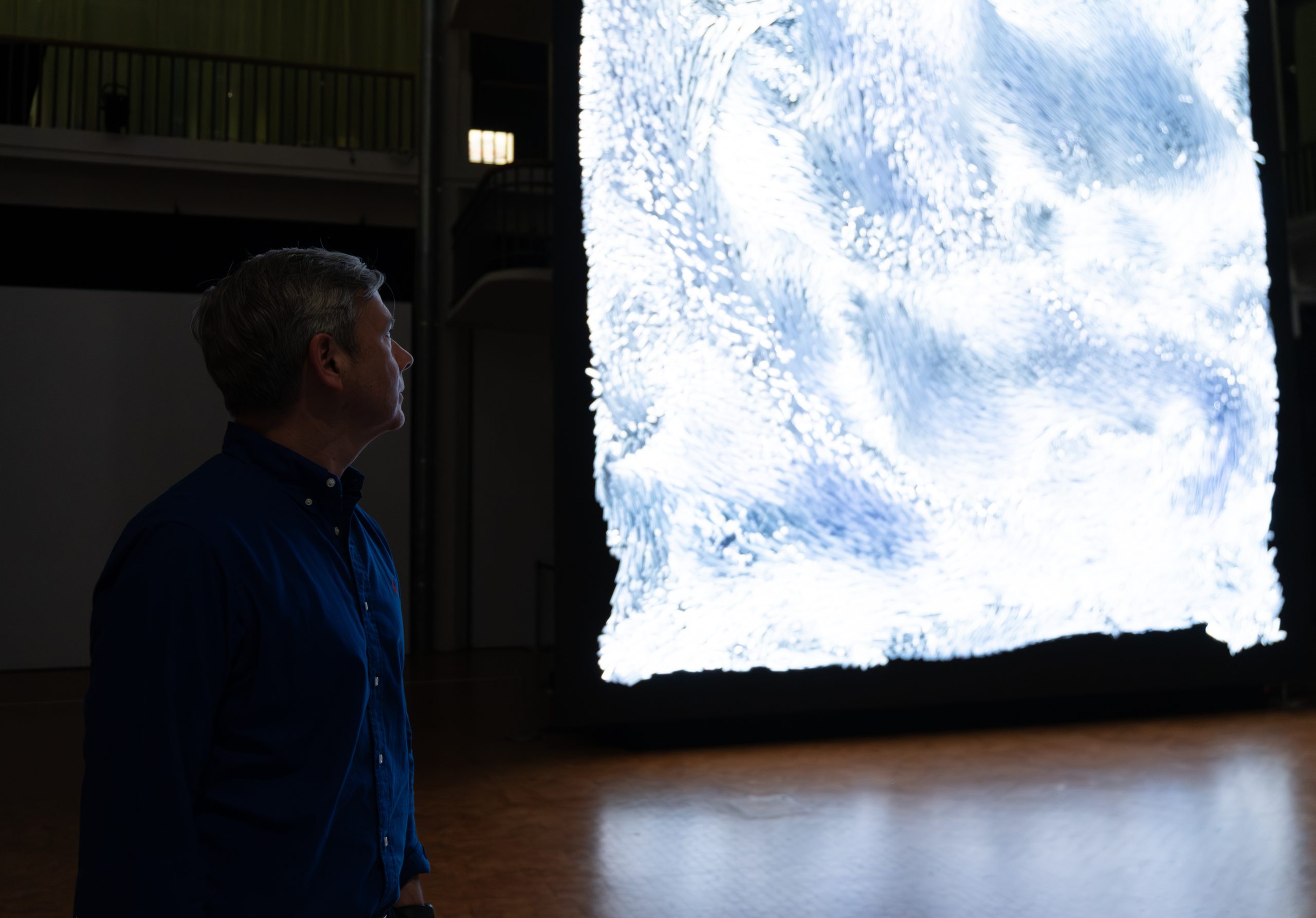
“Speaking of visibility,” we say, and ask about the “Colorful Night of Digitalization.” Holger Neinhaus smiles, almost as if the transition were too deliberate. “Basically, these are great formats,” he says as we continue walking through the hall. “People want events. They want to experience something.” The casual setting and the movement from place to place create exactly the kind of connection to topics that would otherwise remain abstract.
Between the Regular Meeting and Soccer
We’re slowly coming to the end of our conversation. Before we go, we want to know one more thing: What does a typical workday look like? “I start the morning with exercise,” he says. “I’m in the office by nine o’clock.” What follows is a list that shows that “typical workday” is a relative term: regular meetings with various teams, program meetings, department head meetings, and workshops for “ZKM 2028,” a development project with over twenty subprojects. “And I make sure to spend an hour at the museum every day to see how visitors experience everything.” Things quiet down around 5:00 p.m. Then he works through his emails in peace.
And how does he unwind? He laughs. “I have a soft spot for soccer.” But also for culture. “That’s why I like Karlsruhe so much—because the art and culture scene is so incredibly diverse for a city of this size.” He lists them: the jazz club, P8, the area around the Schlachthof. “There’s a lot to discover.”
As we leave the ZKM, we take one last look back at the long facade. We spend a little while reflecting on our conversation with Holger Neinhaus—a man who has spent decades transforming companies and who now, with the same approach, leads a cultural institute.