
Women in IT professions: Karlsruhe initiatives promote women from elementary school to university
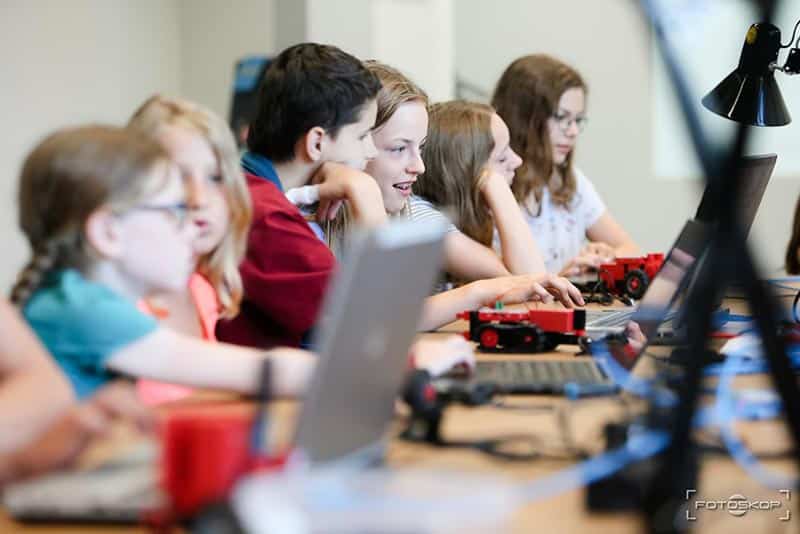
Why do so few women study computer science? Projects such as the video series WIT // Women in IT at KIT show how this can be changed.
After graduating from high school, Vera Chekan and Laura Merker, like many other high school graduates, initially didn’t know what they wanted to study. They both chose to study at the Faculty of Computer Science at the Karlsruhe Institute of Technology (KIT). “I was always enthusiastic about mathematics, but at some point I realized that it was very theoretical. I wanted to do something more specific. And so I chose computer science,” reports Vera Chekan in the video of the WIT // Women in IT series at KIT.
Numerous statistics show that this is still an unusual decision, as very few female high school graduates think of working in the IT sector. Computer science is still a male-dominated field, both in terms of training and, as a result, later in professional life. This has consequences: More than one in ten companies (11 percent) in the IT sector have no women in their workforce. In 76 percent of companies, the proportion of women is less than 25 percent and in only 7 percent of companies is it between 26 and 50 percent, according to a recent study by the industry association Bitkom. Even at KIT, only 12% of students are currently female. Studies show that persistent clichés about the discipline (the “nerd factor”) and misconceptions about studying and everyday working life have been proven to deter many girls (and boys) from studying computer science.
Growing need for support for girls and women
How can this be changed? Politicians, research institutions and schools have been trying to attract more young female talent for years. The digital economy also wants to promote women more. For example, 24% of the companies surveyed by Bitkom have set themselves targets to increase the proportion of women. “Mixed teams are extremely important for the success of companies. And we depend on women to counter the shortage of skilled workers and ensure sustainable growth. The figures are a wake-up call,” says Sabine Bendiek, Vice President of Bitkom, summing up the study results.
There are national initiatives such as Girl’s Day, a nationwide project to provide girls with career and study guidance for professions or subjects in which the proportion of women is below 40 percent. Or Komm, mach MINT, which promotes mathematics, engineering and natural sciences.
Numerous initiatives, including in Kalrsruhe
As part of the technika | Karlsruhe Technology Initiative, CyberForum e.V. has developed the “Girls’ Digital Camps” transfer project for Karlsruhe, which has been successfully implemented since 2019/2020. Dirk Fox, Managing Director of CyberForum and member of the steering committee of karlsruhe.digital, was awarded the Federal Cross of Merit last year for his commitment to getting children interested in technology and IT while they are still at school.
Through practical approaches, the camps aim to lower inhibitions, strengthen the use of technology and provide concrete insights into digital applications and professional fields. Regular company visits show the students how diverse, creative, future-oriented and socially relevant digital applications and IT professions are.

Girls from the 10th grade onwards can test their interest in technology in a trial course at Karlsruhe University of Applied Sciences and get a taste of campus life. Workshops, lab tours, lectures for schoolgirls from all faculties and regular lectures from the first and second semesters in all degree programs provide an insight into studying. Information on study options and applications as well as discussions with students who will talk about their experiences round off the program.
The digital LEARNTEC xChange formats, which were co-initiated by karlsruhe.digital steering committee member Prof. Peter A. Henning, are also dedicated to the topic in individual events. For example, the online workshop “Inspiring women for data and AI professions with corporate e-learning” shows how companies can attract female talent with the help of reskilling initiatives in the field of data & AI and how diversity can drive data forward using real-life examples.
KIT video series aims to break down barriers and arouse interest
The Institute of Computer Science at KIT also participates in nationwide initiatives such as Girl’s Day, which takes place this year on April 28, with its own program. In addition, the institute is taking its own approach to increasing the proportion of women in the subject in the long term, reducing prejudices and providing a more accurate picture of studies and careers. With WIT // Women in IT, a video series has been launched in which women report on their very own experiences with IT at various stages of their studies, lives and careers.
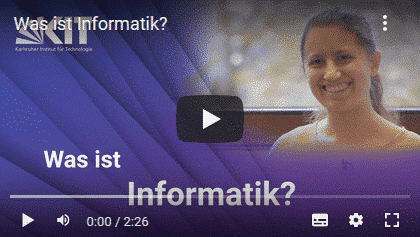
In several videos, five female computer scientists describe their experiences and the challenges of studying computer science. In addition to student Vera Chekan and doctoral student Laura Merker, Katja Werling, who holds a doctorate in computer science and is a software developer for medical technology, Franziska Wegner, who holds a doctorate in computer science, and Professor Anne Koziolek also have their say and report on their studies and professional lives. “We want to make women in IT visible and show them possible role models for a career in computer science,” says Koziolek, explaining one reason for the project. The aim is also to show young women the many different career paths after studying computer science.
Social rethinking required
According to Anne Koziolek, the reasons for the low proportion of women in computer science and other so-called STEM subjects are complex. The main aim of the WIT project was to break down false stereotypes and arouse interest in computer science.

“Maths lectures are definitely the most difficult in the first semester,” says Laura Merker, for example. However, it was important to realize that everyone feels the same way and that you get support in study groups. The surplus of men didn’t play a role for her. “Some people asked whether I really wanted to do this to myself,” Merker continues. But for her, it was more of an incentive.
KIT has recognized the imbalance and launched several projects such as “Girls for Computer Science” to specifically address schoolgirls and female students. In order to get more women interested in computer science in the future, however, Koziolek believes that a social rethink is also needed. “It seems as if computer science is often not shortlisted as a subject for girls to study in the first place.”