
Virtual Reality at KIT: Now anyone can experiment with neutrinos
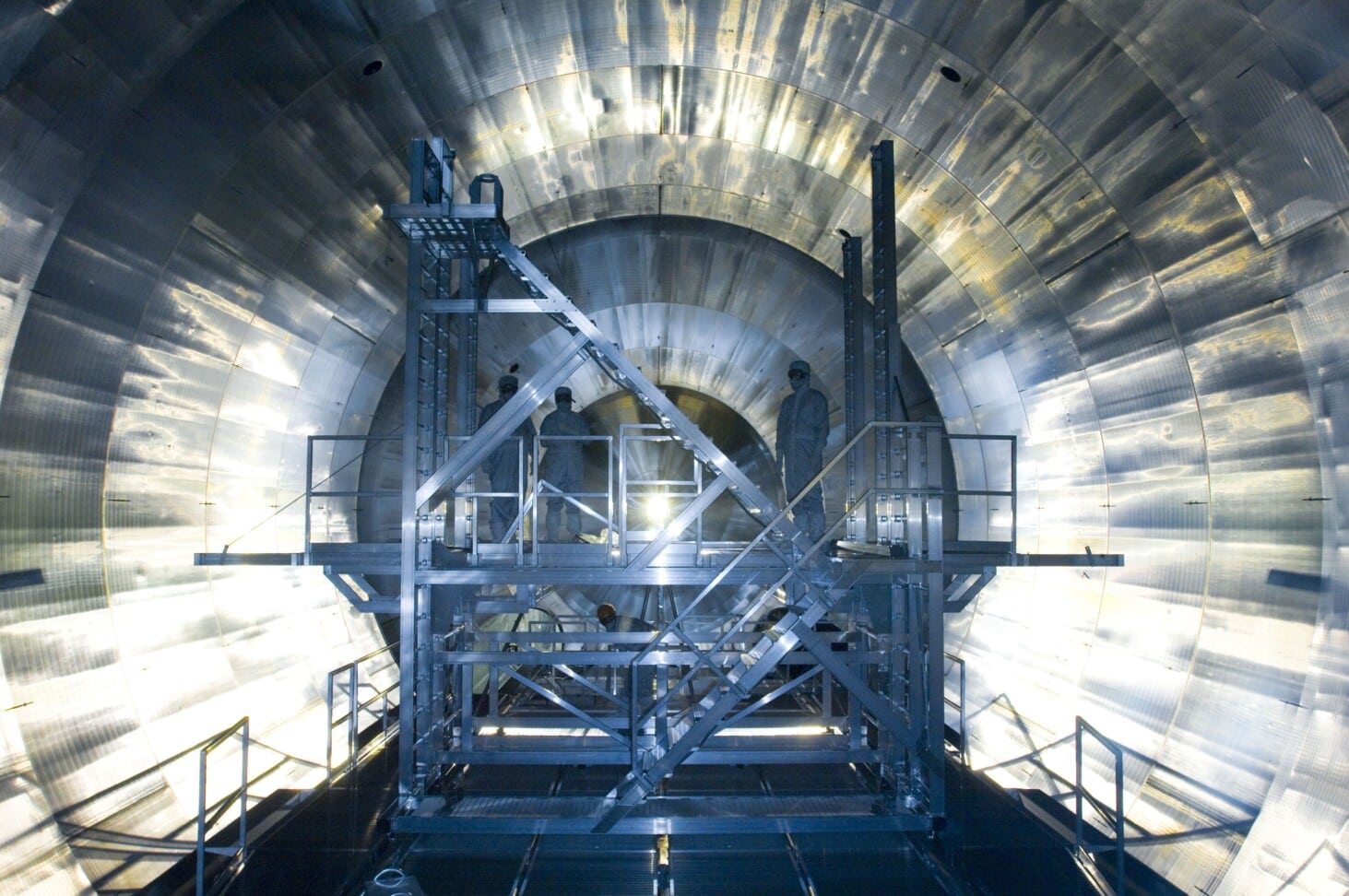
Since the beginning of July, a virtual reality environment has made the KATRIN neutrino experiment at KIT accessible to everyone.
Do neutrinos have a mass? This question is considered one of the greatest mysteries of natural science. KIT, the Karlsruhe Institute of Technology, is trying to find the answer with KATRIN.
It is important to know that neutrinos are the lightest, most common, but also the most mysterious mass-bearing particles in our universe. They are electrically neutral and only interact with their surroundings via gravity and the so-called weak force. For a long time, neutrinos were described as massless particles, until it was observed in recent years that they do have a small mass.
As part of KATRIN, an international basic physics research project, the neutrino mass is now being determined to an accuracy of 0.2 eV/c2. Around 200 researchers from Europe and the USA are currently working on the “visionary tritium beta decay experiment”, which uses a high-resolution spectrometer with a diameter of ten meters.
Sounds complicated? It is. But KIT has come up with something to make KATRIN accessible to everyone.
Thanks to the VR environment, everyone can experiment with KATRIN
In principle, large-scale experiments such as KATRIN take place behind closed doors – partly for safety reasons and partly so as not to disrupt ongoing research work.
Nevertheless, it was important to KIT that anyone interested in the topic should be able to take a look behind the scenes – and so a new type of VR application was developed in the “Science In Presentations” research project in cooperation with the National Institute for Science Communication (NaWik).
The focus is on photorealistic 360-degree views of the experimental setup of the KATRIN experiment at KIT. Users can choose between a guided tour with scientists who explain the research, or they can set off on their own. You can navigate from room to room, talk to virtual researchers and even carry out interactive experiments on the spectrometer yourself.
Interested parties can access the VR application via this link in their browser and go on an exploration tour directly on their PC, tablet or smartphone.

Virtual reality applications in teaching
However, it is not only the public that will benefit from such virtual reality applications in the future, but also teaching. The VR application is currently being further developed by NaWik and the KIT Center for Elementary Particles and Astroparticle Physics (KCETA) so that students can also gain practical experience in virtual space.
The project is financed with funds from the KIT’s “Research Infrastructures in Research-Oriented Teaching” funding program as part of the Excellence Strategy of the German federal and state governments.
Photo: Karlsruhe Research Center