
Start-up city Karlsruhe: From the technology factory to the CyberLab
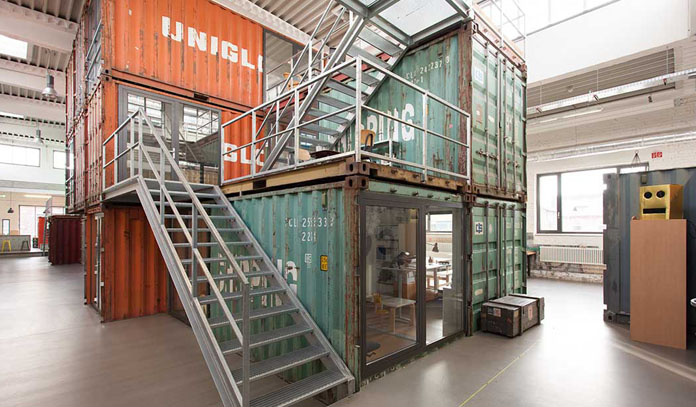
Cover picture: Perfekt Futur Alter Schlachthof
When the Technologiefabrik Karlsruhe was officially opened in 1984 in a renovated industrial building in Karlsruhe’s Oststadt district, IT companies were still exotic in Germany and start-ups were a foreign concept. Today, the start-up center is more popular than ever and one of the beacons in Karlsruhe’s dynamic start-up landscape.
Almost three decades after the opening of the Technologiefabrik, business start-ups are very much in vogue, and in the Karlsruhe TechnologyRegion they are specifically promoted by numerous organizations and institutions. The proximity to numerous renowned universities and research institutions is just as important a location factor as the broad support network of medium-sized companies. “Karlsruhe is a really good place for start-ups in the IT sector,” says Matthias Hornberger, Chairman of CyberForum. The Hightech.Unternehmer.Netzwerk has been promoting spin-offs for years, and numerous former start-ups are now among the more than 1,000 CyberForum member companies.

Smart Production Park is a new lighthouse project
Bringing a historic industrial facility to life with a fresh entrepreneurial spirit – this basic principle of the Technology Factory has since served as a model for the establishment of 12 Karlsruhe start-up centers. For the CyberForum ‘s start-up accelerator CyberLab, modern office space for young entrepreneurs was set up in the old malthouse of the Hoepfner private brewery. However, a good working atmosphere is only one factor in the success of a functioning start-up lab. At least as important is the professional support of the founders through a broad network of experienced mentors.
“Almost nobody can hold a candle to the young people in the start-ups in their specialist field. But it takes more than just technical know-how to establish a company on the market,” says Hornberger. Several dozen companies have already established themselves on the market from the CyberLab thanks to the sound advice provided. And the construction of the Smart Production Park, a multi-storey office building with space for 20 companies on Rintheimer Strasse, which is due to be occupied in the fall of 2022, will provide Karlsruhe’s start-up scene with its next flagship project.
Business incubators for the creative industries at the Alter Schlachthof
The east side of the Alter Schlachthof creative center has also undergone major construction in recent years. On the border to Messplatz, the Festigungs- und Expansionszentrum (FUX) and the neighboring building are two architectural landmarks at the eastern entrance to the city. Companies from the creative industries have the opportunity to develop further in the two twin buildings. Some of the current tenants come from Perfekt Futur opposite the Tollhaus cultural center. The Gründerschmiede is a real Karlsruhe showcase project, not only because of the overseas containers that have been converted into offices, but also because networking between the individual players is particularly important here with short distances.

Continuous expansion of the infrastructure
Networking is also the top priority at other start-up centers. The start-up center on Durlacher Allee is operated by the business development agency, as is the Seboldzentrum in Durlach and the “Dax 74” in the Stadtwerke headquarters on Daxlander Straße, which gives its name. There is also space for start-ups in the Pfaff business and service park in the Durlach space factory.
However, universities are still the nucleus of the start-up generation. Even at the Karlsruhe Institute of Technology (KIT) and Karlsruhe University of Applied Sciences (HKA) , time is not standing still. Lectures on entrepreneurship are now just as much a part of the program there as seminars on business planning for founders. The university group PionierGarage is also a contact point for students who want to start their own business. Numerous innovative students meet there to discuss possible ideas for spin-offs. The annual highlight is the GROW start-up award ceremony.
Continuation of a success story
However, Karlsruhe was a city full of pioneering spirit even before the first start-ups moved into the Technologiefabrik. After all, the building of the current generation of founders was used for the production of sewing machines for many years. Names such as Gritzner, Haid and Neu left their mark on Karlsruhe during industrialization and left a lasting impression on the city. If the old halls are now being filled with new life, this is not only a sensible conversion, but also the continuation of a real success story.